
Join Our JEE Preparation Group
Prep with like-minded aspirants; Get access to free daily tests and study material.
Sign in
Please select an account to continue using cracku.in
↓ →
Join Our JEE Preparation Group
Prep with like-minded aspirants; Get access to free daily tests and study material.
The transfer characteristic curve of a transistor, having input and output resistance 100 Ω and 100 kΩ respectively, is shown in the figure. The voltage and power gain, are respectively:
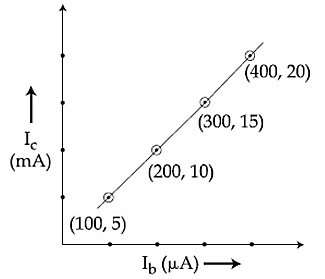
The graph supplied in the question is the transfer (current-current) characteristic of the transistor, that is, it plots the small-signal output current $$\Delta I_{out}$$ (collector current) against the corresponding small-signal input current $$\Delta I_{in}$$ (base current). The slope of this straight-line graph is therefore
$$\beta \;=\; \frac{\Delta I_{out}}{\Delta I_{in}},$$
which is the small-signal current gain $$A_i$$ of the transistor. From the figure we read that for every $$1\text{ mA}$$ change in input current the output current changes by $$50\text{ mA}$$, so
$$A_i \;=\; \beta \;=\; 50.$$
We are asked next for the voltage gain. First we recall the general relationship connecting voltage gain, current gain and the resistances of the input and output circuits. For small signals,
$$A_v \;=\; \frac{\Delta V_{out}}{\Delta V_{in}}.$$
Now $$\Delta V_{out} = \Delta I_{out}\,R_{out}$$ and $$\Delta V_{in} = \Delta I_{in}\,R_{in}$$, so substituting these into the above definition gives
$$A_v \;=\; \frac{\Delta I_{out}\,R_{out}}{\Delta I_{in}\,R_{in}} \;=\; \left(\frac{\Delta I_{out}}{\Delta I_{in}}\right)\! \left(\frac{R_{out}}{R_{in}}\right).$$
We already have $$\dfrac{\Delta I_{out}}{\Delta I_{in}} = 50$$, and the data in the statement give the resistances
$$R_{in} = 100\ \Omega , \qquad R_{out} = 100\ \text{k}\Omega = 1.0\times10^{5}\ \Omega.$$
Hence
$$A_v \;=\; 50 \times \frac{1.0\times10^{5}}{100} \;=\; 50 \times 1000 \;=\; 5.0 \times 10^{4}.$$
Finally, the power gain is required. The small-signal power gain is defined as
$$A_p \;=\; \frac{\text{output power}}{\text{input power}} \;=\; \frac{\Delta V_{out}\,\Delta I_{out}} {\Delta V_{in}\,\Delta I_{in}} \;=\; A_v \times A_i.$$
Substituting the numerical values we have just obtained,
$$A_p \;=\; \left(5.0 \times 10^{4}\right)\!\times 50 \;=\; 2.5 \times 10^{6}.$$
Thus the voltage gain is $$5 \times 10^{4}$$ and the power gain is $$2.5 \times 10^{6}$$.
Hence, the correct answer is Option A.
Was this solution helpful?
Create a FREE account and get:
_1.webp)

Educational materials for JEE preparation

Ask our AI anything

AI can make mistakes. Please verify important information.
AI can make mistakes. Please verify important information.
