
Join Our JEE Preparation Group
Prep with like-minded aspirants; Get access to free daily tests and study material.
Sign in
Please select an account to continue using cracku.in
↓ →
Join Our JEE Preparation Group
Prep with like-minded aspirants; Get access to free daily tests and study material.
Refer to the circuit diagram given in the figure. which of the following observations are correct?
A. Total resistance of circuit is $$6\Omega$$
B. Current in Ammeter is 1 A
C. Potential across AB is 4 Volts.
D. Potential across CD is 4 Volts
E. Total resistance of the circuit is $$8\Omega$$ .
Choose the correct answer from the options given below:
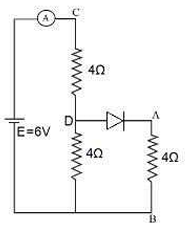
Analyze the orientation of the diode in the given circuit. The positive terminal of the 6V battery is connected to the p-side of the diode through the top resistor, and the n-side is connected to the negative terminal through the resistor AB. This means the diode is forward-biased.
Assuming it is an ideal diode, it acts as a short circuit with zero resistance.
equivalent resistance of the parallel part (between node D and the negative terminal):
$$ R_p = \frac{4 \times 4}{4 + 4} $$
$$ R_p = \frac{16}{8} $$
$$ R_p = 2 \Omega $$
$$ R_{total} = R_{CD} + R_p $$
$$ R_{total} = 4 + 2 $$
$$ R_{total} = 6 \Omega $$
So A correct and E incorrect.
Calculate the total current ($$I$$) flowing through the circuit, which is the reading of the ammeter:
$$ I = \frac{E}{R_{total}} $$
$$ I = \frac{6}{6} $$
$$ I = 1 \text{ A} $$
This makes observation B correct.
Calculate the potential difference across the resistor between C and D ($$V_{CD}$$):
$$ V_{CD} = I \times R_{CD} $$
$$ V_{CD} = 1 \times 4 $$
$$ V_{CD} = 4 \text{ V} $$
This makes observation D correct.
Calculate the potential difference across AB ($$V_{AB}$$). The diode is ideal, so there is no voltage drop across it. The voltage across the branch AB is the same as the total voltage across the parallel combination.
$$ V_{AB} = I \times R_p $$
$$ V_{AB} = 1 \times 2 $$
$$ V_{AB} = 2 \text{ V} $$
This makes observation C incorrect.
Therefore, the correct observations are A, B, and D.
Was this solution helpful?
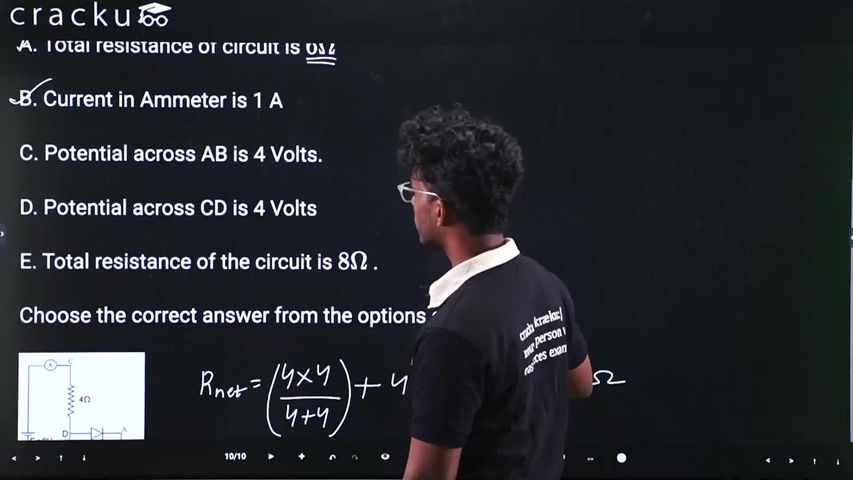
Click on the Email ☝️ to Watch the Video Solution
Create a FREE account and get:
_1.webp)

Educational materials for JEE preparation

Ask our AI anything

AI can make mistakes. Please verify important information.
AI can make mistakes. Please verify important information.
