
Join Our JEE Preparation Group
Prep with like-minded aspirants; Get access to free daily tests and study material.
Sign in
Please select an account to continue using cracku.in
↓ →
Join Our JEE Preparation Group
Prep with like-minded aspirants; Get access to free daily tests and study material.
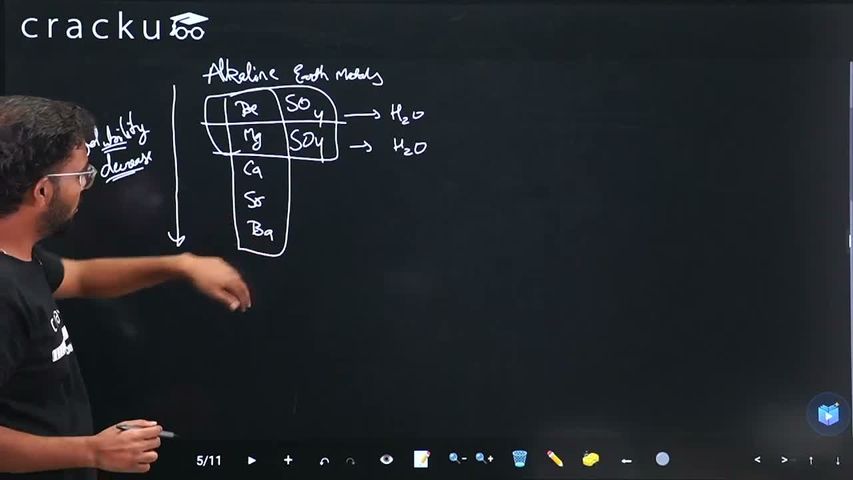
Among the sulphates of alkaline earth metals, the solubilities of $$\text{BeSO}_4$$ and $$\text{MgSO}_4$$ in water, respectively, are:
We have to compare the solubilities of the sulphates of two successive Group 2 (alkaline-earth) elements, namely $$\text{BeSO}_4$$ and $$\text{MgSO}_4$$, when they are placed in water. To do this we recall the general principle that, for an ionic solid to dissolve, the magnitude of its hydration enthalpy must at least compensate for its lattice enthalpy.
For any salt $$\text{M}^{2+}\text{SO}_4^{2-}$$ belonging to the alkaline-earth series, two energetic quantities are important:
1. Lattice enthalpy, written $$\Delta H_{\text{lattice}},$$ which arises from the electrostatic attraction inside the crystal. 2. Hydration enthalpy, written $$\Delta H_{\text{hyd}},$$ which is released when the gaseous ions $$\text{M}^{2+}$$ and $$\text{SO}_4^{2-}$$ are surrounded by water molecules.
The overall enthalpy change for dissolution is
$$\Delta H_{\text{solution}} = \Delta H_{\text{lattice}} + \Delta H_{\text{hyd}}.$$
If $$\Delta H_{\text{solution}}$$ is negative or only slightly positive, the salt is appreciably soluble; if it is strongly positive, the salt remains largely undissolved.
Now we examine the periodic-trend arguments step by step:
• As we move down the Group 2 column, the ionic radius of $$\text{M}^{2+}$$ increases. So $$r_{\text{Be}^{2+}} < r_{\text{Mg}^{2+}} < r_{\text{Ca}^{2+}} \ldots$$
• Because lattice enthalpy roughly varies as $$\dfrac{z^{+}z^{-}}{r^{+}+r^{-}},$$ a larger cation radius decreases lattice enthalpy. Hence $$\Delta H_{\text{lattice}}$$ becomes less negative (weaker in magnitude) from BeSO4 to MgSO4 to CaSO4, and so on.
• Hydration enthalpy varies approximately as $$\dfrac{z^{2}}{r},$$ so a smaller cation radius gives a more negative (more exothermic) $$\Delta H_{\text{hyd}}.$$ Therefore the hydration enthalpy decreases markedly as we move down the group.
Combining the two trends:
Be}^{2+}: \; \Delta H_{\text{lattice}} \text{ very large negative}, \; \Delta H_{\text{hyd}} \text{ even more negative
Because the hydration enthalpy dominates, $$\Delta H_{\text{solution}}$$ is sufficiently negative, so $$\text{BeSO}_4$$ dissolves readily — it is highly soluble.
Mg}^{2+}: \; \Delta H_{\text{lattice}} \text{ slightly smaller in magnitude}, \; \Delta H_{\text{hyd}} \text{ still large though less than Be}^{2+
The hydration enthalpy still outweighs the lattice enthalpy, and $$\Delta H_{\text{solution}}$$ remains near zero or slightly negative. Hence $$\text{MgSO}_4$$ is also highly soluble in water. (Indeed, the familiar Epsom salt is $$\text{MgSO}_4\cdot7\text{H}_2\text{O},$$ which dissolves easily.)
Starting with $$\text{CaSO}_4$$ and continuing to $$\text{BaSO}_4,$$ the hydration enthalpy drops below the lattice enthalpy, making those sulphates sparingly soluble; however, our question concerns only BeSO4 and MgSO4.
So the solubility pattern obtained is:
$$\text{BeSO}_4 : \text{ high}$$
$$\text{MgSO}_4 : \text{ high}$$
This matches Option C in the given list.
Hence, the correct answer is Option C.
Was this solution helpful?
Click on the Email ☝️ to Watch the Video Solution
Create a FREE account and get:
_1.webp)

Educational materials for JEE preparation

Ask our AI anything

AI can make mistakes. Please verify important information.
AI can make mistakes. Please verify important information.
