
Join Our JEE Preparation Group
Prep with like-minded aspirants; Get access to free daily tests and study material.
Sign in
Please select an account to continue using cracku.in
↓ →
Join Our JEE Preparation Group
Prep with like-minded aspirants; Get access to free daily tests and study material.
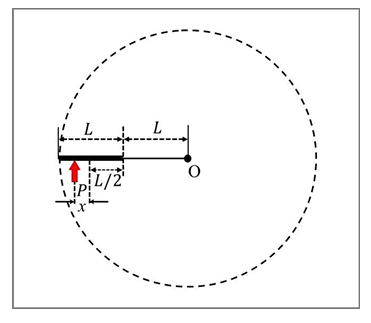
A thin uniform rod of length $$L$$ and certain mass is kept on a frictionless horizontal table with a massless string of length $$L$$ fixed to one end (top view is shown in the figure). The other end of the string is pivoted to a point $$O$$. If a horizontal impulse $$P$$ is imparted to the rod at a distance $$x = L/n$$ from the mid-point of the rod (see figure), then the rod and string revolve together around the point $$O$$, with the rod remaining aligned with the string. In such a case, the value of $$n$$ is ______.
Correct Answer: 18
Let the mass of the uniform rod be $$m$$ and let its mid-point be $$C$$. The string of length $$L$$ is attached to the rod at point $$A$$ (one end of the rod) and the other end of the string is fixed to the pivot $$O$$. Hence the points are collinear in the order $$O \;-\; A \;-\; C$$, with $$OA = L$$ and $$AC = L/2$$, so
$$OC = OA + AC = L + \frac{L}{2} = \frac{3L}{2}$$
An impulsive force delivers a (linear) impulse $$P$$ perpendicular to the rod at a point that is a distance $$x = \frac{L}{n}$$ away from the mid-point $$C$$ along the length of the rod.
Linear motion of the centre of mass
The entire impulse $$P$$ is received by the rod, so the centre of mass acquires a linear momentum $$P$$ and hence a speed
$$v_C = \frac{P}{m}$$
Angular motion about the centre of mass
The same impulse produces an angular impulse (about the centre) equal to $$P x$$.
For a thin uniform rod, the moment of inertia about its mid-point is
$$I_C = \frac{1}{12}\,mL^{2}$$
Therefore the angular velocity of the rod about its own centre is
$$\omega = \frac{P x}{I_C} = \frac{P x}{\tfrac{1}{12}mL^{2}} = \frac{12\,P\,x}{mL^{2}}$$
Condition for the rod to remain aligned with the string
For the rod and string to revolve rigidly about the fixed point $$O$$, the motion after the impulse must be a pure rotation about $$O$$.
In pure rotation, the linear speed of the centre of mass must satisfy
$$v_C = \omega \, OC$$
Substituting $$v_C = \dfrac{P}{m}$$, $$\omega = \dfrac{12Px}{mL^{2}}$$ and $$OC = \dfrac{3L}{2}$$ gives
$$\frac{P}{m} = \frac{12Px}{mL^{2}} \times \frac{3L}{2} = \frac{18P x}{mL}$$
Cancel $$P/m$$ from both sides:
$$1 = \frac{18x}{L} \quad\Longrightarrow\quad x = \frac{L}{18}$$
Since the point of application was specified as $$x = \dfrac{L}{n}$$ from the mid-point, we equate
$$\frac{L}{n} = \frac{L}{18} \quad\Longrightarrow\quad n = 18$$
Hence the required value is
18
Was this solution helpful?
Create a FREE account and get:
_1.webp)

Educational materials for JEE preparation

Ask our AI anything

AI can make mistakes. Please verify important information.
AI can make mistakes. Please verify important information.
