
Join Our JEE Preparation Group
Prep with like-minded aspirants; Get access to free daily tests and study material.
Sign in
Please select an account to continue using cracku.in
↓ →
Join Our JEE Preparation Group
Prep with like-minded aspirants; Get access to free daily tests and study material.
The number of terms of an A.P. is even; the sum of all the odd terms is 24, the sum of all the even terms is 30 and the last term exceeds the first by $$\frac{21}{2}$$. Then the number of terms which are integers in the A.P. is :
Let the first term be $$a$$ and the common difference be $$d$$. Because the number of terms is even, write the progression as $$2n$$ terms.
The last term is $$T_{2n}=a+(2n-1)d$$. Given that it exceeds the first term by $$\frac{21}{2}$$, we have $$a+(2n-1)d-a=\frac{21}{2} \;\Longrightarrow\;(2n-1)d=\frac{21}{2}$$ $$\Rightarrow\; d=\frac{21}{2(2n-1)} \;-(1)$$
Odd-positioned terms are $$T_1,T_3,\dots,T_{2n-1}$$. The $$k^{\text{th}}$$ odd term is $$a+(2k-2)d$$. Sum of $$n$$ odd terms: $$S_{\text{odd}}=\frac{n}{2}\Bigl[2a+(n-1)\,2d\Bigr]=n\bigl(a+(n-1)d\bigr)$$ Given $$S_{\text{odd}}=24$$, so $$n\bigl(a+(n-1)d\bigr)=24 \;\Longrightarrow\; a+(n-1)d=\frac{24}{n} \;-(2)$$
Even-positioned terms are $$T_2,T_4,\dots,T_{2n}$$. The $$k^{\text{th}}$$ even term is $$a+(2k-1)d$$. Sum of $$n$$ even terms: $$S_{\text{even}}=\frac{n}{2}\Bigl[2(a+d)+(n-1)\,2d\Bigr]=n\bigl(a+nd\bigr)$$ Given $$S_{\text{even}}=30$$, so $$n\bigl(a+nd\bigr)=30 \;\Longrightarrow\; a+nd=\frac{30}{n} \;-(3)$$
Subtract $$(2)$$ from $$(3)$$:
$$\bigl(a+nd\bigr)-\bigl(a+(n-1)d\bigr)=d=\frac{30}{n}-\frac{24}{n}=\frac{6}{n} \;-(4)$$
Equate $$(4)$$ with $$(1)$$:
$$\frac{6}{n}=\frac{21}{2(2n-1)}$$ Cross-multiplying: $$6\cdot2(2n-1)=21n$$ $$12(2n-1)=21n$$ $$24n-12=21n \;\Longrightarrow\;3n=12\;\Longrightarrow\; n=4$$
The total number of terms is $$2n=8$$, and from $$(4)$$ $$d=\frac{6}{n}=\frac{6}{4}=\frac{3}{2}$$
Find $$a$$ using $$(2)$$: $$a+(n-1)d=\frac{24}{n}\;\Longrightarrow\;a+3\left(\frac{3}{2}\right)=6$$ $$a+\frac{9}{2}=6\;\Longrightarrow\;a=\frac{3}{2}$$
The eight terms are $$T_k=a+(k-1)d=\frac{3}{2}+(k-1)\cdot\frac{3}{2},\;k=1,2,\dots,8$$
Listing them: $$\frac{3}{2},\,3,\,\frac{9}{2},\,6,\,\frac{15}{2},\,9,\,\frac{21}{2},\,12$$.
Integers among these are $$3,\,6,\,9,\,12$$, i.e. $$4$$ terms.
Hence, the number of integer terms in the A.P. is $$4$$ ⇒ Option A.
Was this solution helpful?
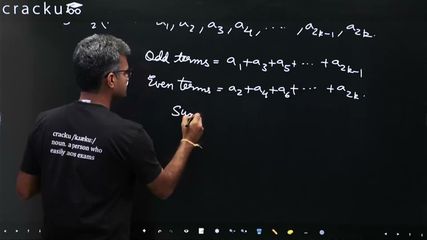
Click on the Email ☝️ to Watch the Video Solution
Create a FREE account and get:
_1.webp)

Educational materials for JEE preparation

Ask our AI anything

AI can make mistakes. Please verify important information.
AI can make mistakes. Please verify important information.


