
Join Our JEE Preparation Group
Prep with like-minded aspirants; Get access to free daily tests and study material.
Sign in
Please select an account to continue using cracku.in
↓ →
Join Our JEE Preparation Group
Prep with like-minded aspirants; Get access to free daily tests and study material.
Let $$f : [1, \infty) \to [2, \infty)$$ be a differentiable function. If $$10\int_{1}^{x} f(t)\,dt = 5xf(x) - x^5 - 9$$ for all $$x \geq 1$$, then the value of $$f(3)$$ is :
The functional equation is given for all $$x \ge 1$$:
$$10\int_{1}^{x} f(t)\,dt = 5x\,f(x) \;-\; x^{5} \;-\; 9 \qquad -(1)$$
Step 1: Differentiate both sides of $$(1)$$ with respect to $$x$$.
• By the Fundamental Theorem of Calculus, $$\dfrac{d}{dx}\Bigl[10\int_{1}^{x} f(t)\,dt\Bigr] = 10\,f(x)$$.
• For the right‐hand side use the product rule on $$5x\,f(x)$$:
$$\dfrac{d}{dx}\!\left[5x\,f(x) - x^{5} - 9\right] = 5\Bigl[f(x) + x\,f'(x)\Bigr] \;-\; 5x^{4}$$
Equating the two derivatives:
$$10f(x) = 5f(x) + 5x\,f'(x) - 5x^{4}$$
Simplify by dividing every term by $$5$$:
$$2f(x) = f(x) + x\,f'(x) - x^{4}$$
Rearrange to obtain the first-order linear differential equation:
$$x\,f'(x) - f(x) = x^{4} \qquad -(2)$$
Step 2: Write $$(2)$$ in standard linear form.
Divide by $$x$$ (valid for $$x \gt 0$$):
$$f'(x) \;-\; \dfrac{1}{x}\,f(x) = x^{3} \qquad -(3)$$
Step 3: Solve $$(3)$$ using an integrating factor.
For a linear ODE $$f' + P(x)f = Q(x)$$, the integrating factor is $$\mu(x)=e^{\int P(x)\,dx}$$.
Here $$P(x)= -\dfrac{1}{x}$$, so
$$\mu(x)= e^{\int -\frac{1}{x}\,dx}=e^{-\ln x}=x^{-1}$$
Multiply $$(3)$$ by $$\mu(x)=x^{-1}$$:
$$\dfrac{f'(x)}{x} \;-\; \dfrac{f(x)}{x^{2}} = x^{2}$$
The left side is the derivative of $$\dfrac{f(x)}{x}$$ because
$$\dfrac{d}{dx}\Bigl[\dfrac{f(x)}{x}\Bigr] = \dfrac{x\,f'(x) - f(x)}{x^{2}}$$
Comparing with $$(2)$$ confirms this fact. Therefore
$$\dfrac{d}{dx}\Bigl[\dfrac{f(x)}{x}\Bigr] = x^{2}$$
Integrate both sides from $$1$$ to $$x$$:
$$\dfrac{f(x)}{x} - \dfrac{f(1)}{1} = \int_{1}^{x} t^{2}\,dt = \left[\dfrac{t^{3}}{3}\right]_{1}^{x} = \dfrac{x^{3}-1}{3}$$
Hence
$$\dfrac{f(x)}{x} = \dfrac{f(1)}{1} + \dfrac{x^{3}-1}{3}$$
Multiply by $$x$$:
$$f(x) = \dfrac{x^{4}}{3} \;+\; Cx \qquad\text{where}\quad C = f(1) - \dfrac{1}{3}$$
Step 4: Find the constant $$C$$ using the condition at $$x=1$$.
Put $$x=1$$ in $$(1)$$:
Left side: $$10\int_{1}^{1} f(t)\,dt = 0$$.
Right side: $$5(1)f(1) - 1^{5} - 9 = 5f(1) - 10$$.
Equate: $$0 = 5f(1) - 10 \;\Longrightarrow\; f(1) = 2$$.
Therefore
$$C = 2 - \dfrac{1}{3} = \dfrac{5}{3}$$
So the explicit form of $$f$$ is
$$f(x) = \dfrac{x^{4}}{3} + \dfrac{5x}{3} = \dfrac{x^{4} + 5x}{3}$$
Step 5: Evaluate $$f(3)$$.
$$f(3) = \dfrac{3^{4} + 5\cdot 3}{3} = \dfrac{81 + 15}{3} = \dfrac{96}{3} = 32$$
Hence $$f(3) = 32$$.
The correct option is Option B.
Was this solution helpful?
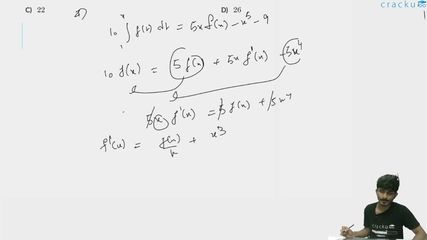
Click on the Email ☝️ to Watch the Video Solution
Create a FREE account and get:
_1.webp)

Educational materials for JEE preparation

Ask our AI anything

AI can make mistakes. Please verify important information.
AI can make mistakes. Please verify important information.


