
Join Our JEE Preparation Group
Prep with like-minded aspirants; Get access to free daily tests and study material.
Sign in
Please select an account to continue using cracku.in
↓ →
Join Our JEE Preparation Group
Prep with like-minded aspirants; Get access to free daily tests and study material.
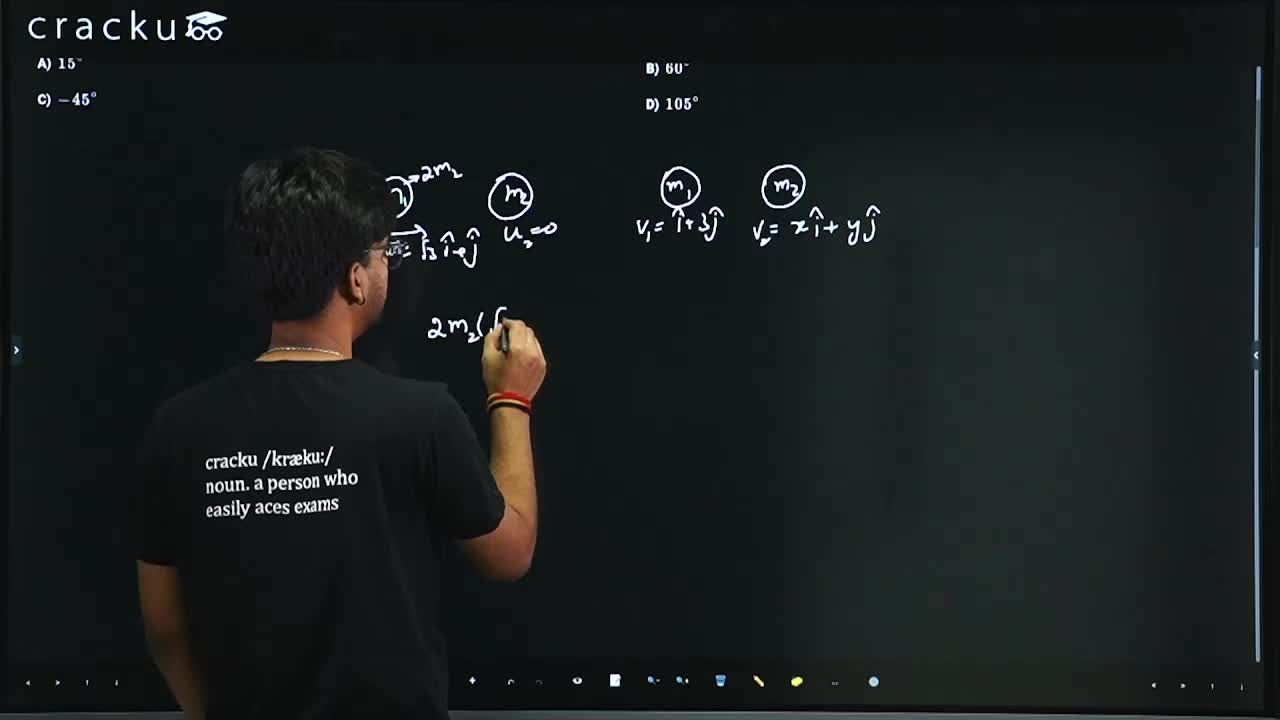
Particle A of mass $$m_1$$ moving with velocity $$(\sqrt{3}\hat{i} + \hat{j})\,\text{ms}^{-1}$$ collides with another particle B of mass $$m_2$$ which is at rest initially. Let $$\vec{v}_1$$ and $$\vec{v}_2$$ be the velocities of particles A and B after collision respectively. If $$m_1 = 2m_2$$ and after collision $$\vec{v}_1 - (\hat{i} + \sqrt{3}\hat{j})\,\text{ms}^{-1}$$, the angle between $$\vec{v}_1$$ and $$\vec{v}_2$$ is:
We have particle A with mass $$m_1$$ and initial velocity $$\vec u_1 = \left(\sqrt{3}\,\hat i + \hat j\right)\,\text{m s}^{-1}$$. Particle B has mass $$m_2$$ and is initially at rest, so $$\vec u_2 = \vec 0$$. After the collision the given velocity of A is $$\vec v_1 = \left(\hat i + \sqrt{3}\,\hat j\right)\,\text{m s}^{-1}$$, while the velocity of B is the unknown vector $$\vec v_2 = a\,\hat i + b\,\hat j$$. The masses are related by $$m_1 = 2m_2$$.
Because the collision takes place in isolation, the law of conservation of linear momentum applies:
$$m_1\vec u_1 + m_2\vec u_2 = m_1\vec v_1 + m_2\vec v_2.$$
Substituting the known quantities and remembering that $$\vec u_2 = \vec 0$$ we get
$$m_1\left(\sqrt{3}\,\hat i + \hat j\right) = m_1\left(\hat i + \sqrt{3}\,\hat j\right) + m_2\left(a\,\hat i + b\,\hat j\right).$$
We now compare the $$\hat i$$ and $$\hat j$$ components separately. First, however, it is convenient to express $$m_2$$ in terms of $$m_1$$. Since $$m_1 = 2m_2$$ we have $$m_2 = \dfrac{m_1}{2}$$.
$$\hat i$$-components:
$$m_1\sqrt{3} = m_1\cdot 1 + \dfrac{m_1}{2}\,a.$$
Dividing by $$m_1$$ gives
$$\sqrt{3} = 1 + \dfrac{a}{2}\;\;\Longrightarrow\;\;\dfrac{a}{2} = \sqrt{3}-1\;\;\Longrightarrow\;\;a = 2\!\left(\sqrt{3}-1\right).$$
$$\hat j$$-components:
$$m_1\cdot 1 = m_1\sqrt{3} + \dfrac{m_1}{2}\,b.$$
Again dividing by $$m_1$$ we obtain
$$1 = \sqrt{3} + \dfrac{b}{2}\;\;\Longrightarrow\;\;\dfrac{b}{2} = 1-\sqrt{3} = -\!\left(\sqrt{3}-1\right)\;\;\Longrightarrow\;\;b = -2\!\left(\sqrt{3}-1\right).$$
Thus the velocity of particle B after the collision is
$$\vec v_2 = a\,\hat i + b\,\hat j = 2\!\left(\sqrt{3}-1\right)\hat i - 2\!\left(\sqrt{3}-1\right)\hat j = 2\!\left(\sqrt{3}-1\right)\left(\hat i - \hat j\right)\,\text{m s}^{-1}.$$
Let us call the angle between $$\vec v_1$$ and $$\vec v_2$$ by the symbol $$\theta$$. To find it we use the definition
$$\cos\theta = \dfrac{\vec v_1\!\cdot\!\vec v_2}{\lvert\vec v_1\rvert\,\lvert\vec v_2\rvert}.$$
Dot product:
$$\vec v_1\!\cdot\!\vec v_2 = \bigl(1\,\hat i + \sqrt{3}\,\hat j\bigr)\!\cdot\! \Bigl[2\bigl(\sqrt{3}-1\bigr)\,(\hat i - \hat j)\Bigr]$$ $$= 2\!\left(\sqrt{3}-1\right)\left[1\cdot 1 + \sqrt{3}\,(-1)\right] = 2\!\left(\sqrt{3}-1\right)\left(1-\sqrt{3}\right) = -2\!\left(\sqrt{3}-1\right)^{\!2}.$$
Magnitudes:
$$\lvert\vec v_1\rvert = \sqrt{1^{2} + (\sqrt{3})^{2}} = \sqrt{1+3} = 2,$$ $$\lvert\vec v_2\rvert = 2\!\left(\sqrt{3}-1\right)\sqrt{\,(\hat i - \hat j)\!\cdot\!(\hat i - \hat j)} = 2\!\left(\sqrt{3}-1\right)\sqrt{1+1} = 2\!\left(\sqrt{3}-1\right)\sqrt{2}.$$
Cosine of the angle:
$$\cos\theta = \dfrac{-2\!\left(\sqrt{3}-1\right)^{2}} {2 \times 2\!\left(\sqrt{3}-1\right)\sqrt{2}} = \dfrac{-\left(\sqrt{3}-1\right)}{2\sqrt{2}} \approx \dfrac{-0.732}{2.828} \approx -0.259.$$
The value $$\cos\theta = -0.259$$ corresponds to an angle of approximately $$105^\circ$$ (since $$\cos105^\circ \approx -0.2588$$).
Hence, the correct answer is Option D.
Was this solution helpful?
Click on the Email ☝️ to Watch the Video Solution
Create a FREE account and get:
_1.webp)

Educational materials for JEE preparation

Ask our AI anything

AI can make mistakes. Please verify important information.
AI can make mistakes. Please verify important information.


