
Join Our JEE Preparation Group
Prep with like-minded aspirants; Get access to free daily tests and study material.
Sign in
Please select an account to continue using cracku.in
↓ →
Join Our JEE Preparation Group
Prep with like-minded aspirants; Get access to free daily tests and study material.
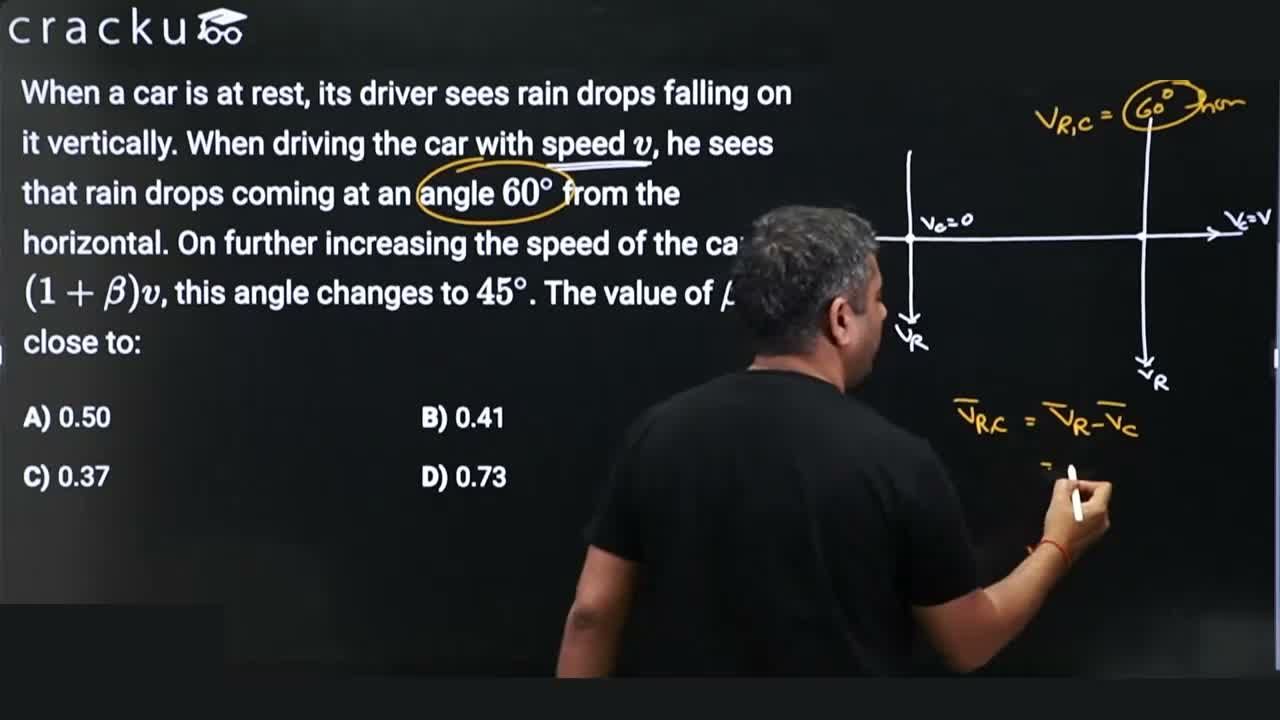
When a car is at rest, its driver sees rain drops falling on it vertically. When driving the car with speed $$v$$, he sees that rain drops coming at an angle $$60^\circ$$ from the horizontal. On further increasing the speed of the car to $$(1+\beta)v$$, this angle changes to $$45^\circ$$. The value of $$\beta$$ is close to:
First let us choose a convenient coordinate system. We take the horizontal road surface as the $$x$$-axis and the vertically downward direction (the direction in which raindrops actually fall) as the negative $$y$$-axis. All speeds mentioned are measured with respect to the ground.
When the car is standing still, the driver observes the rain to be falling exactly vertically downward. Because the car is at rest in this situation, the velocity of the rain relative to the ground must itself be vertical. We therefore write the ground-frame velocity of the rain as
$$\vec u=-u\,\hat{\jmath},$$
where $$u>0$$ is the speed of the rain and the minus sign signifies the downward (negative $$y$$) direction.
Now the car starts moving to the right (positive $$x$$-direction) with speed $$v$$. The ground-frame velocity of the car is then
$$\vec v_c = v\,\hat{\imath}.$$
The driver in the car does not see the ground-frame velocity of the rain; instead he sees the relative velocity of the rain with respect to the car. The standard formula for relative velocity is stated first:
$$\vec v_{\text{rain relative to car}}=\vec u-\vec v_c.$$
Substituting the expressions for $$\vec u$$ and $$\vec v_c$$ we obtain
$$\vec v_{rc}=(-u\,\hat{\jmath})-(v\,\hat{\imath})=-v\,\hat{\imath}-u\,\hat{\jmath}.$$
The driver now sees this vector making an angle of $$60^\circ$$ with the horizontal. The horizontal component is $$|-v|=v$$ and the vertical component is $$|-u|=u$$, so from the definition of the tangent of an angle we have
$$\tan 60^\circ=\frac{\text{vertical component}}{\text{horizontal component}}=\frac{u}{v}.$$
Using $$\tan 60^\circ=\sqrt3$$ gives
$$\sqrt3=\frac{u}{v}\quad\Longrightarrow\quad u=v\sqrt3. \quad -(1)$$
Next the car’s speed is increased to $$(1+\beta)v$$. Its new ground-frame velocity becomes
$$\vec v_c'=(1+\beta)v\,\hat{\imath}.$$
The new relative velocity of the rain with respect to the faster car is
$$\vec v_{rc}'=\vec u-\vec v_c'=(-u\,\hat{\jmath})-(1+\beta)v\,\hat{\imath}=-(1+\beta)v\,\hat{\imath}-u\,\hat{\jmath}.$$
This time the driver measures the angle made by this vector with the horizontal to be $$45^\circ$$. Therefore
$$\tan 45^\circ=\frac{u}{(1+\beta)v}.$$
Because $$\tan 45^\circ=1$$, we get
$$1=\frac{u}{(1+\beta)v}\quad\Longrightarrow\quad u=(1+\beta)v. \quad -(2)$$
We now have two expressions, (1) and (2), for the same quantity $$u$$. Equating them gives
$$v\sqrt3=(1+\beta)v.$$
Since $$v\neq0$$, we can cancel $$v$$ from both sides to obtain
$$\sqrt3=1+\beta\quad\Longrightarrow\quad\beta=\sqrt3-1.$$
Using $$\sqrt3\approx1.732$$ we calculate
$$\beta\approx1.732-1=0.732\;(\text{approximately}).$$
The closest option to this value is $$0.73$$.
Hence, the correct answer is Option D.
Was this solution helpful?
Click on the Email ☝️ to Watch the Video Solution
Create a FREE account and get:
_1.webp)

Educational materials for JEE preparation

Ask our AI anything

AI can make mistakes. Please verify important information.
AI can make mistakes. Please verify important information.


