
Join Our JEE Preparation Group
Prep with like-minded aspirants; Get access to free daily tests and study material.
Sign in
Please select an account to continue using cracku.in
↓ →
Join Our JEE Preparation Group
Prep with like-minded aspirants; Get access to free daily tests and study material.
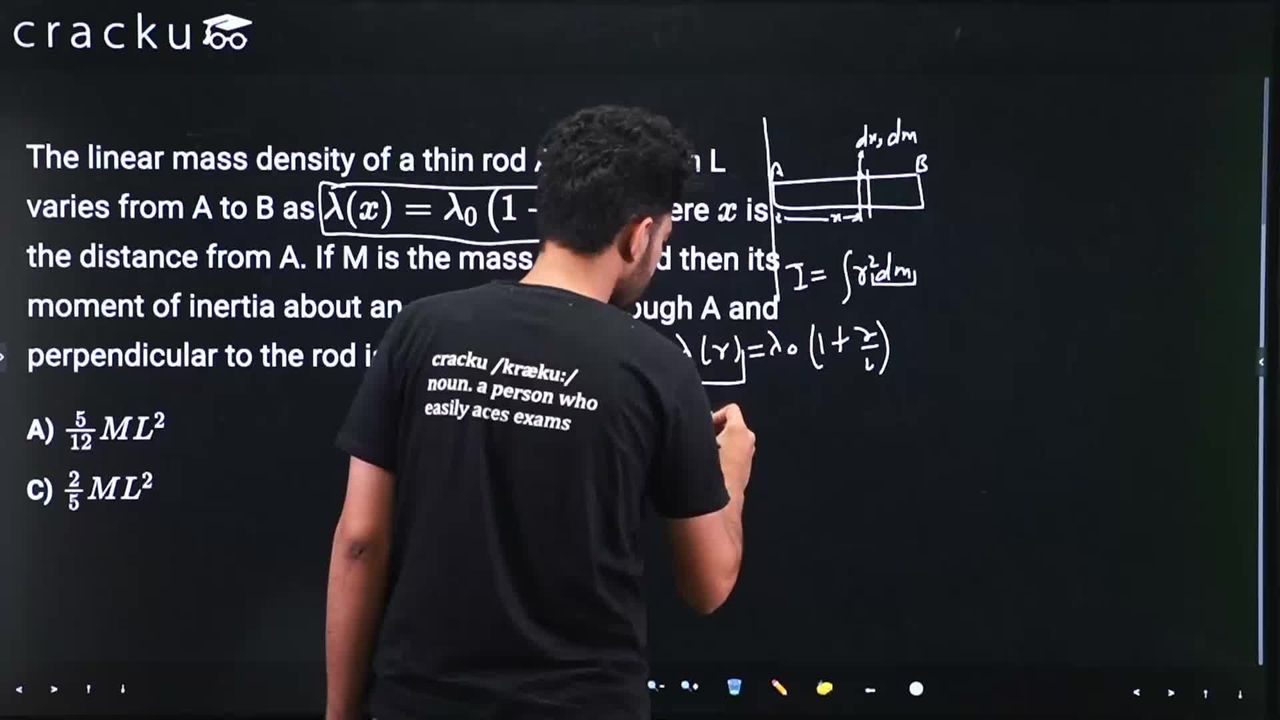
The linear mass density of a thin rod AB of length L varies from A to B as $$\lambda(x) = \lambda_0\left(1 + \frac{x}{L}\right)$$, where $$x$$ is the distance from A. If M is the mass of the rod then its moment of inertia about an axis passing through A and perpendicular to the rod is:
We begin by translating the information given in the statement into mathematical form. The linear mass density (mass per unit length) of the rod at a point that is at a distance $$x$$ from the end A is
$$\lambda(x)=\lambda_0\left(1+\frac{x}{L}\right).$$
To calculate the moment of inertia about an axis passing through A and perpendicular to the rod, two main steps are needed:
1. Express the constant $$\lambda_0$$ in terms of the total mass $$M$$ and the length $$L$$ of the rod.
2. Substitute this expression for $$\lambda_0$$ into the general integral formula for moment of inertia.
We tackle each in detail.
Step 1: Relating $$\lambda_0$$ to the total mass $$M$$.
By definition, the total mass of the rod is obtained by integrating its linear density along its entire length. Hence
$$M=\int_{0}^{L}\lambda(x)\,dx.$$
Substituting the given density function, we have
$$M=\int_{0}^{L}\lambda_0\left(1+\frac{x}{L}\right)\,dx.$$
Because $$\lambda_0$$ is a constant, it can be taken outside the integral:
$$M=\lambda_0\int_{0}^{L}\left(1+\frac{x}{L}\right)\,dx.$$
We now integrate term by term:
$$\int_{0}^{L}1\,dx = \left[x\right]_{0}^{L}=L,$$
$$\int_{0}^{L}\frac{x}{L}\,dx=\frac{1}{L}\int_{0}^{L}x\,dx =\frac{1}{L}\left[\frac{x^{2}}{2}\right]_{0}^{L} =\frac{1}{L}\cdot\frac{L^{2}}{2} =\frac{L}{2}.$$
Adding the two contributions gives
$$\int_{0}^{L}\left(1+\frac{x}{L}\right)\,dx = L+\frac{L}{2}=\frac{3L}{2}.$$
Therefore,
$$M=\lambda_0\left(\frac{3L}{2}\right).$$
Solving for $$\lambda_0$$ gives
$$\lambda_0 = \frac{2M}{3L}.$$
Step 2: Calculating the moment of inertia $$I$$.
The standard continuous-mass formula for moment of inertia is
$$I=\int r^{2}\,dm,$$
where here the perpendicular distance from the axis (through A) to a small element at position $$x$$ is just $$r=x$$. Also, for a thin rod, an infinitesimal mass element $$dm$$ is related to its length element $$dx$$ through $$dm=\lambda(x)\,dx$$.
Thus
$$I=\int_{0}^{L}x^{2}\,dm =\int_{0}^{L}x^{2}\,\lambda(x)\,dx =\int_{0}^{L}x^{2}\,\lambda_0\left(1+\frac{x}{L}\right)\,dx.$$
Pulling out the constant $$\lambda_0$$ gives
$$I=\lambda_0\int_{0}^{L}\left(x^{2}+\frac{x^{3}}{L}\right)\,dx.$$
We now integrate each term individually.
First term: $$\int_{0}^{L}x^{2}\,dx=\left[\frac{x^{3}}{3}\right]_{0}^{L}=\frac{L^{3}}{3}.$$
Second term: $$\int_{0}^{L}\frac{x^{3}}{L}\,dx=\frac{1}{L}\int_{0}^{L}x^{3}\,dx =\frac{1}{L}\left[\frac{x^{4}}{4}\right]_{0}^{L} =\frac{1}{L}\cdot\frac{L^{4}}{4} =\frac{L^{3}}{4}.$$
Adding these two integrals yields
$$\int_{0}^{L}\left(x^{2}+\frac{x^{3}}{L}\right)\,dx =\frac{L^{3}}{3}+\frac{L^{3}}{4} =L^{3}\left(\frac{1}{3}+\frac{1}{4}\right) =L^{3}\left(\frac{4}{12}+\frac{3}{12}\right) =L^{3}\left(\frac{7}{12}\right) =\frac{7L^{3}}{12}.$$
Therefore,
$$I=\lambda_0\left(\frac{7L^{3}}{12}\right).$$
Substituting $$\lambda_0=\dfrac{2M}{3L}$$ into this expression, we get
$$I=\left(\frac{2M}{3L}\right)\left(\frac{7L^{3}}{12}\right) =\frac{2\cdot7\,M\,L^{2}}{3\cdot12} =\frac{14\,M\,L^{2}}{36} =\frac{7\,M\,L^{2}}{18}.$$
Thus, the moment of inertia of the rod about the given axis is
$$I=\frac{7}{18}ML^{2}.$$
Comparing with the options provided, we see that this matches option B.
Hence, the correct answer is Option B.
Was this solution helpful?
Click on the Email ☝️ to Watch the Video Solution
Create a FREE account and get:
_1.webp)

Educational materials for JEE preparation

Ask our AI anything

AI can make mistakes. Please verify important information.
AI can make mistakes. Please verify important information.


