
Join Our JEE Preparation Group
Prep with like-minded aspirants; Get access to free daily tests and study material.
Sign in
Please select an account to continue using cracku.in
↓ →
Join Our JEE Preparation Group
Prep with like-minded aspirants; Get access to free daily tests and study material.
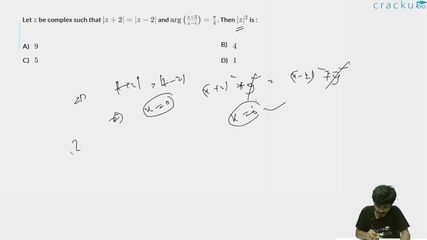
Let $$z$$ be complex such that $$|z + 2| = |z - 2|$$ and $$\arg\left(\frac{z+3}{z-i}\right) = \frac{\pi}{4}$$. Then $$|z|^2$$ is :
First convert each given condition into a geometric/algebraic statement on the complex number $$z = x + iy$$.
Condition 1: $$|z+2| = |z-2|$$ compares the distances of $$z$$ from the fixed points $$-2$$ and $$2$$ on the real axis.
For any point in the plane, the set of locations equidistant from $$-2$$ and $$2$$ is the perpendicular bisector of the segment joining them, i.e. the imaginary axis $$x = 0$$. Hence
$$z = iy,\qquad y \in \mathbb{R}\,.$$
Condition 2: $$\displaystyle \arg\!\left(\frac{z+3}{\,z-i\,}\right)=\frac{\pi}{4}$$.
Insert $$z = iy$$ into the fraction:
$$\frac{z+3}{z-i}=\frac{\,3+iy\,}{\,i(y-1)\,}\,.$$
Divide numerator and denominator by $$i$$ (equivalently multiply by $$-i$$):
$$\frac{3+iy}{i(y-1)} = \frac{-i(3+iy)}{y-1} = \frac{y-3i}{\,y-1\,}\,.$$
Write this quotient in “modulus-argument” form.
Its numerator is the complex number $$y-3i$$ (real part $$y$$, imaginary part $$-3$$), while the denominator $$y-1$$ is purely real. Hence
$$\arg\!\left(\frac{y-3i}{y-1}\right)=\arg(y-3i)-\arg(y-1)\,.$$
Two cases arise, depending on the sign of $$y-1$$.
Case 1: $$y-1\gt0 \;(y\gt1)$$ ⇒ $$\arg(y-1)=0$$.
Then $$\arg(y-3i)=\frac{\pi}{4}$$ is required.
But $$y-3i$$ has negative imaginary part, so its argument lies in the fourth or third quadrant, never at $$\pi/4$$. Thus this case is impossible.
Case 2: $$y-1\lt0 \;(y\lt1)$$ ⇒ $$\arg(y-1)=\pi$$ (negative real axis).
The given condition becomes
$$\arg(y-3i)-\pi = \frac{\pi}{4} \;\;\Longrightarrow\;\; \arg(y-3i)=\frac{\pi}{4}+\pi=\frac{5\pi}{4}\,.$$
The angle $$\tfrac{5\pi}{4}$$ points to the third quadrant where both coordinates are negative, so we must have $$y\lt 0$$. For the complex number $$y-3i$$,
$$\tan\bigl(\arg(y-3i)\bigr)= \frac{\text{imag part}}{\text{real part}}= \frac{-3}{\,y\,} =\tan\!\left(\frac{5\pi}{4}\right)=1\,.$$
This immediately gives $$y=-3$$ (satisfying $$y\lt 1$$ as required).
Therefore $$z = i(-3) = -3i$$.
Finally compute the required modulus-squared:
$$|z|^2 = |-3i|^2 = (-3)^2 = 9\,.$$
Option A which is: 9
Was this solution helpful?
Click on the Email ☝️ to Watch the Video Solution
Create a FREE account and get:
_1.webp)

Educational materials for JEE preparation

Ask our AI anything

AI can make mistakes. Please verify important information.
AI can make mistakes. Please verify important information.


