
Join Our JEE Preparation Group
Prep with like-minded aspirants; Get access to free daily tests and study material.
Sign in
Please select an account to continue using cracku.in
↓ →
Join Our JEE Preparation Group
Prep with like-minded aspirants; Get access to free daily tests and study material.
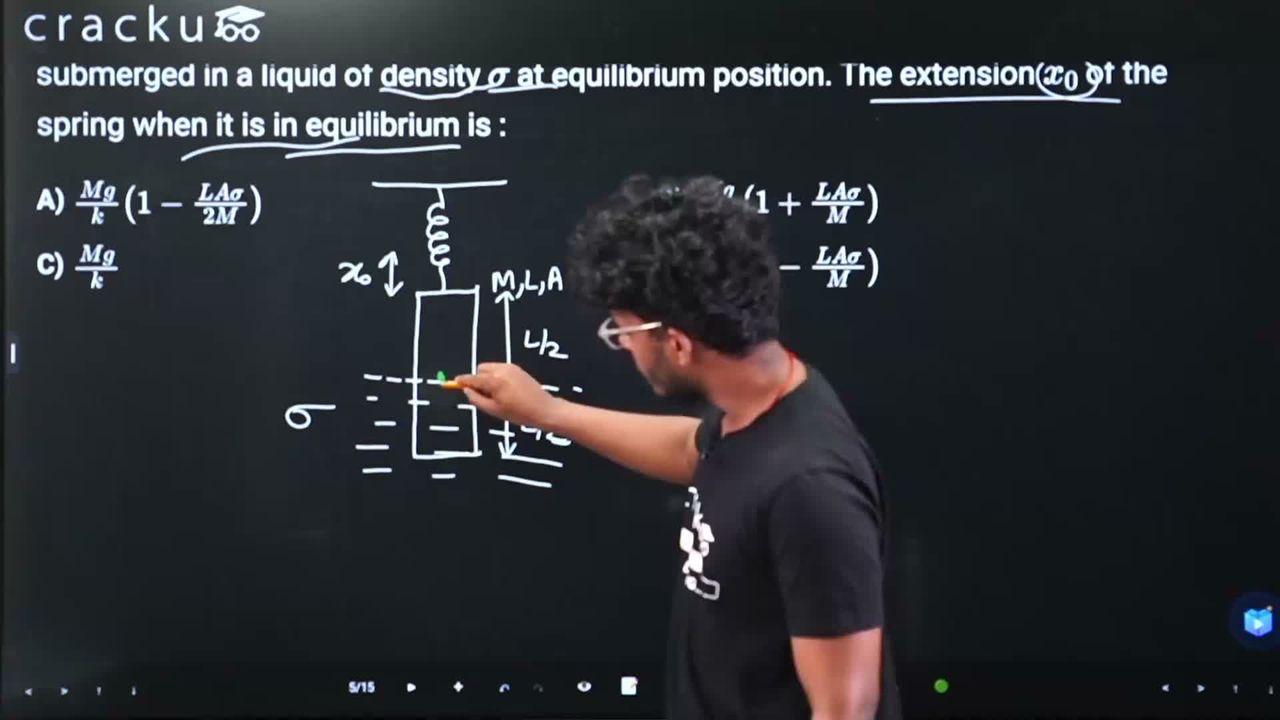
A uniform cylinder of length L and mass M having cross-sectional area A is suspended, with its length vertical, from a fixed point by a massless spring, such that it is half submerged in a liquid of density $$\sigma$$ at equilibrium position. The extension $$x_0$$ of the spring when it is in equilibrium is :
At the equilibrium position the cylinder remains at rest, so the net force acting on it must be zero. We therefore equate the upward forces to the downward forces.
The downward force is simply the weight of the cylinder, given by the well-known expression $$W = Mg,$$ where $$M$$ is the mass of the cylinder and $$g$$ is the acceleration due to gravity.
The upward forces consist of two parts.
First, the restoring force of the massless spring. According to Hooke’s law, the magnitude of the spring force is $$F_{\text{spring}} = kx_0,$$ where $$k$$ is the spring constant and $$x_0$$ is the extension of the spring. This force acts upward because the cylinder pulls the spring downward.
Second, the buoyant force exerted by the liquid. Archimedes’ principle states that the buoyant force equals the weight of the displaced liquid: $$F_{\text{buoyant}} = (\text{mass of displaced liquid})\,g = (\rho V_{\text{sub}})g,$$ where $$\rho$$ (here given as $$\sigma$$) is the density of the liquid and $$V_{\text{sub}}$$ is the submerged volume.
The problem tells us that at equilibrium the cylinder is half submerged. The full volume of the cylinder is $$V_{\text{cyl}} = AL,$$ with $$A$$ as cross-sectional area and $$L$$ as length. Hence the submerged volume is $$V_{\text{sub}} = \frac{1}{2}AL.$$ Substituting this into the buoyant-force formula gives $$F_{\text{buoyant}} = \sigma \left(\frac{1}{2}AL\right) g \;=\; \frac{\sigma AL g}{2}.$$
Now we impose equilibrium. Taking upward forces as positive, we write $$F_{\text{spring}} + F_{\text{buoyant}} - W = 0.$$ Substituting the expressions already obtained, we have $$kx_0 + \frac{\sigma AL g}{2} - Mg = 0.$$
We isolate the term involving $$x_0$$:
$$kx_0 = Mg - \frac{\sigma AL g}{2}.$$
Factoring out $$g$$ from the right-hand side,
$$kx_0 = g\!\left(M - \frac{\sigma AL}{2}\right).$$
Finally, dividing both sides by $$k$$ gives the required extension,
$$x_0 = \frac{g}{k}\!\left(M - \frac{\sigma AL}{2}\right).$$
Pulling out a common factor $$\displaystyle\frac{Mg}{k}$$ we write
$$x_0 = \frac{Mg}{k}\!\left(1 - \frac{\sigma AL}{2M}\right).$$
This expression matches Option A in the list provided.
Hence, the correct answer is Option A.
Was this solution helpful?
Click on the Email ☝️ to Watch the Video Solution
Create a FREE account and get:
_1.webp)

Educational materials for JEE preparation

Ask our AI anything

AI can make mistakes. Please verify important information.
AI can make mistakes. Please verify important information.
