
Join Our JEE Preparation Group
Prep with like-minded aspirants; Get access to free daily tests and study material.
Sign in
Please select an account to continue using cracku.in
↓ →
Join Our JEE Preparation Group
Prep with like-minded aspirants; Get access to free daily tests and study material.
Uniform magnetic fields of different strengths ($$B_1$$ and $$B_2$$), both normal to the plane of the paper exist as shown in the figure. A charged particle of mass m and charge q, at the interface at an instant, moves into the region 2 with velocity v and returns to the interface. It continues to move into region 1 and finally reaches the interface. What is the displacement of the particle during this movement along the interface?
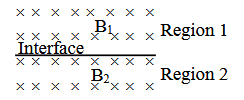
(Consider the velocity of the particle to be normal to the magnetic field and $$B_2 > B_1$$)
When a charged particle ($$q, m$$) enters a uniform magnetic field ($$B$$) with velocity ($$v$$) perpendicular to the field, it executes uniform circular motion.
Radius ($$r$$), $$r = \frac{mv}{qB}$$
Region 2:
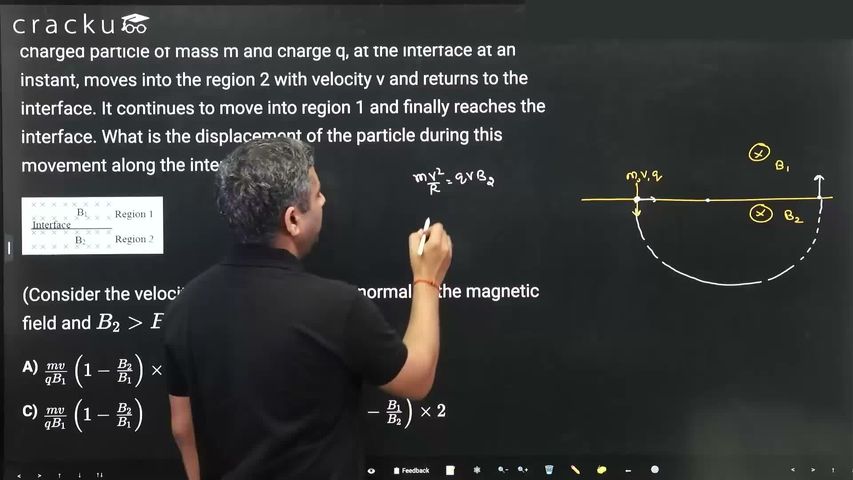
The particle enters Region 2 with magnetic field $$B_2$$. It describes a semicircular arc and returns to the interface.
Radius in Region 2: $$r_2 = \frac{mv}{qB_2}$$
Displacement along the interface: $$d_2 = 2r_2 = \frac{2mv}{qB_2}$$
Assuming a positive charge moving downward, the magnetic force ($$\vec{F} = q\vec{v} \times \vec{B}$$) directed into the page causes the particle to curve to the right.
Region 1:
Upon returning to the interface, the particle enters Region 1 with magnetic field $$B_1$$. Because the velocity vector is now reversed (pointing upward), the force direction also reverses.
Radius in Region 1: $$r_1 = \frac{mv}{qB_1}$$
Displacement along the interface: $$d_1 = 2r_1 = \frac{2mv}{qB_1}$$
The particle now curves to the left.
Net displacement ($$S$$): $$S = |d_1 - d_2|$$
$$S = 2r_1 - 2r_2 = \frac{2mv}{qB_1} - \frac{2mv}{qB_2}$$
$$S = \frac{mv}{qB_1} \left( 1 - \frac{B_1}{B_2} \right) \times 2$$
Was this solution helpful?
Click on the Email ☝️ to Watch the Video Solution
Create a FREE account and get:
_1.webp)

Educational materials for JEE preparation

Ask our AI anything

AI can make mistakes. Please verify important information.
AI can make mistakes. Please verify important information.
