
Join Our JEE Preparation Group
Prep with like-minded aspirants; Get access to free daily tests and study material.
Sign in
Please select an account to continue using cracku.in
↓ →
Join Our JEE Preparation Group
Prep with like-minded aspirants; Get access to free daily tests and study material.
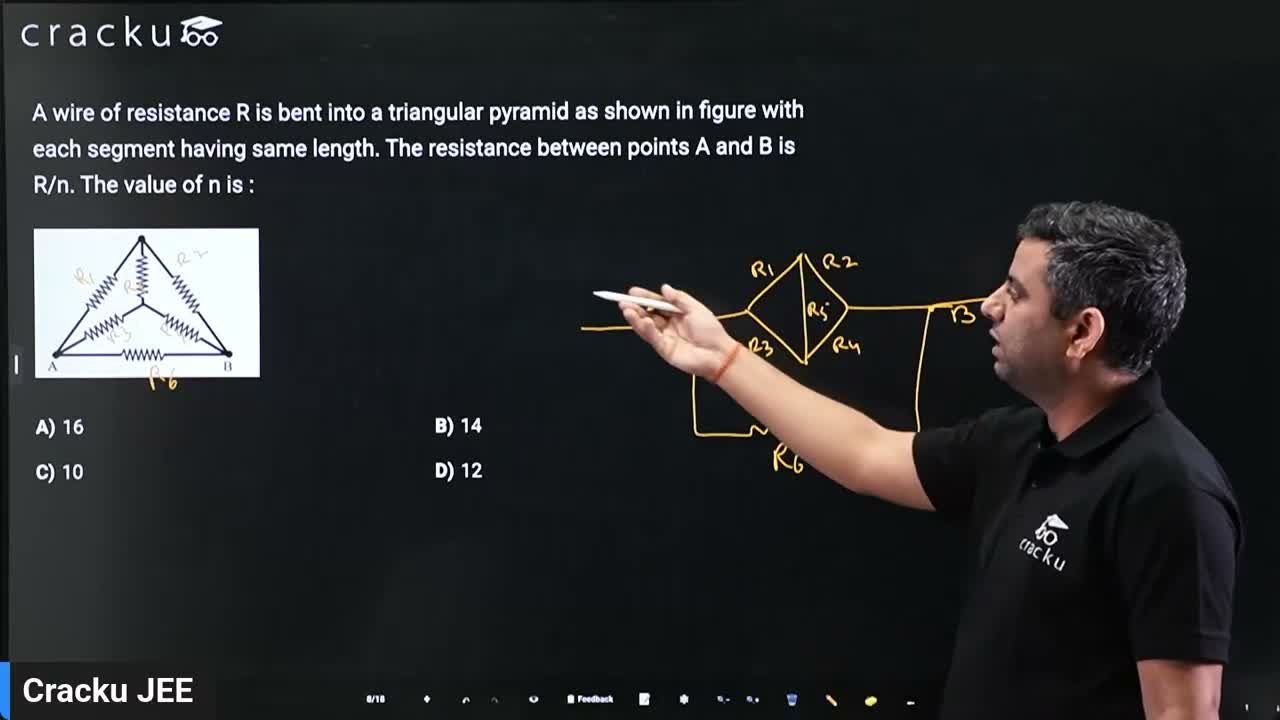
A wire of resistance R is bent into a triangular pyramid as shown in figure with each segment having same length. The resistance between points A and B is R/n. The value of n is :
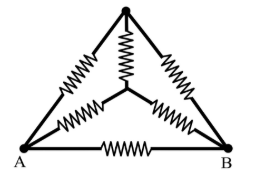
All edges have equal resistance. Total wire resistance = R.
Number of edges in a tetrahedron = 6
So resistance of each edge:
$$r=\frac{R}{6}$$
Now find equivalent between two vertices (say A and B).
By symmetry, the other two vertices are at same potential → no current flows between them.
So that edge can be ignored.
Now circuit reduces to:
So we have 3 parallel paths:
$$R_{eq}=r\parallel2r\parallel2r$$
$$\frac{1}{R_{eq}}=\frac{1}{r}+\frac{1}{2r}+\frac{1}{2r}=\frac{1}{r}+\frac{1}{r}=\frac{2}{r}$$
$$R_{eq}=\frac{r}{2}$$
Substitute $$r=R/6$$
$$R_{eq}=\frac{R}{12}$$
Was this solution helpful?
Click on the Email ☝️ to Watch the Video Solution
Create a FREE account and get:
_1.webp)

Educational materials for JEE preparation

Ask our AI anything

AI can make mistakes. Please verify important information.
AI can make mistakes. Please verify important information.
