
Join Our JEE Preparation Group
Prep with like-minded aspirants; Get access to free daily tests and study material.
Sign in
Please select an account to continue using cracku.in
↓ →
Join Our JEE Preparation Group
Prep with like-minded aspirants; Get access to free daily tests and study material.
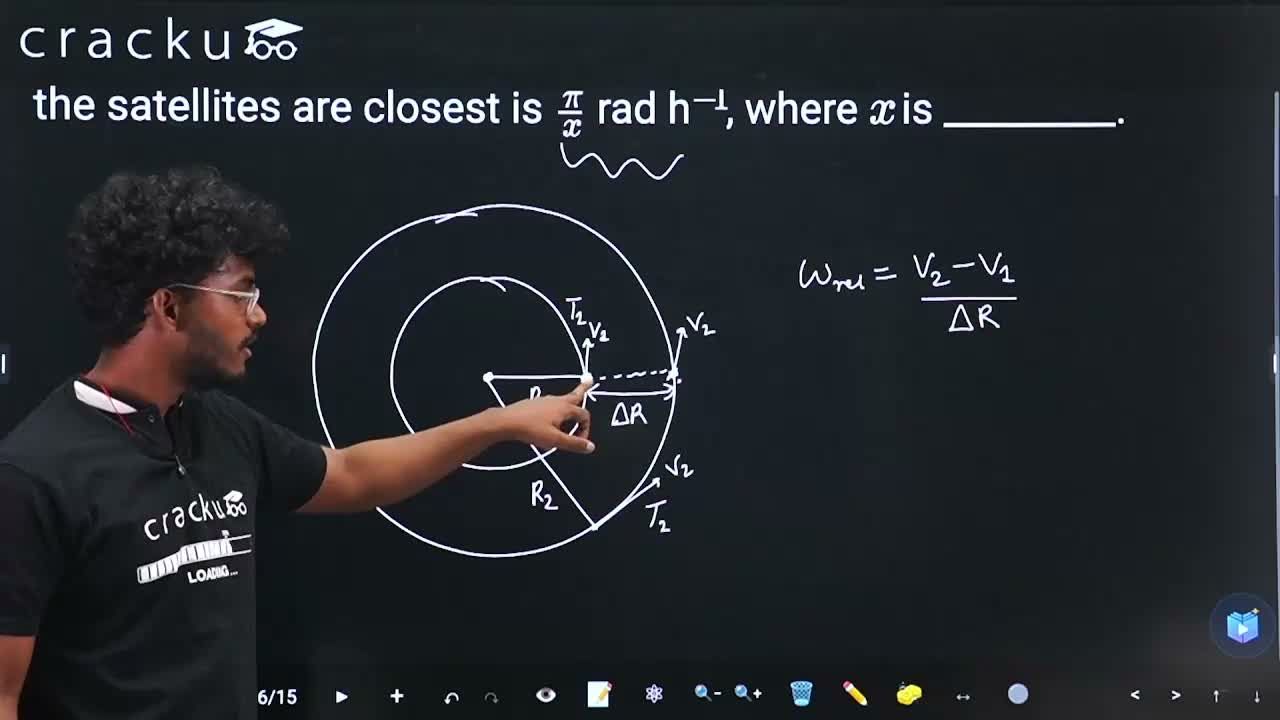
Two satellites revolve around a planet in coplanar circular orbits in anticlockwise direction. Their period of revolutions are 1 hour and 8 hours respectively. The radius of the orbit of nearer satellite is $$2 \times 10^3$$ km. The angular speed of the farther satellite as observed from the nearer satellite at the instant when both the satellites are closest is $$\frac{\pi}{x}$$ rad h$$^{-1}$$, where $$x$$ is _________.
Correct Answer: 3
The two satellites move in uniform circular motion round the same planet and both turn anticlockwise. Let us name the nearer satellite as 1 and the farther satellite as 2. We are given
$$T_1 = 1 \text{ h}, \qquad T_2 = 8 \text{ h}, \qquad r_1 = 2 \times 10^{3}\ \text{km}$$
First we write their angular speeds about the planet. For uniform circular motion the relation is
$$\omega = \frac{2\pi}{T}.$$
So we have
$$\omega_1 = \frac{2\pi}{T_1} = \frac{2\pi}{1} = 2\pi \ \text{rad h}^{-1},$$
$$\omega_2 = \frac{2\pi}{T_2} = \frac{2\pi}{8} = \frac{\pi}{4} \ \text{rad h}^{-1}.$$
The radius of the outer orbit, $$r_2,$$ is not given directly, but the satellites circle the same planet, so Kepler’s third law applies:
$$\frac{T^2}{r^3} = \text{constant for the same planet}.$$
Hence
$$\frac{T_2^2}{r_2^3} = \frac{T_1^2}{r_1^3}\; \Longrightarrow\; r_2 = r_1\biggl(\frac{T_2}{T_1}\biggr)^{2/3}.$$
Substituting $$T_2 = 8 \text{ h},\; T_1 = 1 \text{ h}$$ and $$r_1 = 2 \times 10^{3} \text{ km}$$ gives
$$r_2 = 2 \times 10^{3}\ \text{km} \;\bigl(8\bigr)^{2/3}.$$
Because $$8 = 2^3,$$ we get $$8^{2/3} = (2^3)^{2/3} = 2^{2} = 4,$$ therefore
$$r_2 = 2 \times 10^{3}\ \text{km} \times 4 = 8 \times 10^{3}\ \text{km}.$$
To find how fast the farther satellite seems to move across the sky of an observer on the nearer satellite, we look at the instantaneous rate of change of the angle that the line joining the two satellites makes. Let us place the planet at the origin. At the instant of closest approach (both satellites on the same straight line through the planet) put that line along the $$x$$-axis. A little time $$t$$ later their angular displacements about the planet are $$\theta_1 = \omega_1 t$$ and $$\theta_2 = \omega_2 t.$$ The position vectors are
$$\vec r_1 = r_1(\cos\theta_1\,\hat i + \sin\theta_1\,\hat j),$$
$$\vec r_2 = r_2(\cos\theta_2\,\hat i + \sin\theta_2\,\hat j).$$
The vector from satellite 1 to satellite 2 is
$$\vec R = \vec r_2 - \vec r_1.$$
For small $$t$$ we expand $$\cos\theta \approx 1-\theta^2/2$$ and $$\sin\theta \approx \theta.$$ Then to first order in $$t$$
$$\vec R \approx \bigl(r_2 - r_1\bigr)\hat i + \bigl(r_2\omega_2 - r_1\omega_1\bigr)t\,\hat j.$$
The $$x$$-component is essentially constant, while the $$y$$-component grows linearly. The apparent angle $$\phi$$ measured from the initial line is therefore
$$\tan\phi \approx \frac{(r_2\omega_2 - r_1\omega_1)t}{r_2 - r_1}\; \Longrightarrow\; \phi \approx \frac{(r_2\omega_2 - r_1\omega_1)t}{r_2 - r_1}.$$
Hence the instantaneous angular speed of satellite 2 as seen from satellite 1 is
$$\frac{d\phi}{dt} = \frac{r_2\omega_2 - r_1\omega_1}{\,r_2 - r_1\,}.$$
Substituting the numerical values:
$$r_2\omega_2 = (8 \times 10^{3}\ \text{km})\left(\frac{\pi}{4}\ \text{rad h}^{-1}\right) = 2000\pi\ \text{km h}^{-1},$$
$$r_1\omega_1 = (2 \times 10^{3}\ \text{km})(2\pi\ \text{rad h}^{-1}) = 4000\pi\ \text{km h}^{-1},$$
$$r_2 - r_1 = 8 \times 10^{3}\ \text{km} - 2 \times 10^{3}\ \text{km} = 6 \times 10^{3}\ \text{km}.$$
Therefore
$$\left|\frac{d\phi}{dt}\right| = \left|\frac{2000\pi - 4000\pi}{6 \times 10^{3}}\right| = \left|\frac{-2000\pi}{6000}\right| = \frac{\pi}{3}\ \text{rad h}^{-1}.$$
This matches the form $$\dfrac{\pi}{x}\ \text{rad h}^{-1},$$ so we identify $$x = 3.$$
Hence, the correct answer is Option 3.
Was this solution helpful?
Click on the Email ☝️ to Watch the Video Solution
Create a FREE account and get:
_1.webp)

Educational materials for JEE preparation

Ask our AI anything

AI can make mistakes. Please verify important information.
AI can make mistakes. Please verify important information.
