
Join Our JEE Preparation Group
Prep with like-minded aspirants; Get access to free daily tests and study material.
Sign in
Please select an account to continue using cracku.in
↓ →
Join Our JEE Preparation Group
Prep with like-minded aspirants; Get access to free daily tests and study material.
The voltage across the 10 $$\Omega$$ resistor in the given circuit is $$x$$ volt. The value of $$x$$ to the nearest integer is ________.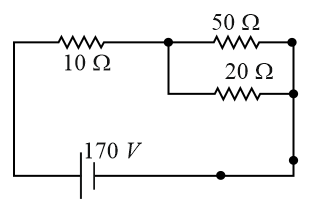
Correct Answer: 70
Let the lower conductor be the reference (zero volt).
The three elements that meet at node A are –
• the left-hand source $$E_1 = 200 \text{ V}$$ in series with $$R_1 = 6 \Omega$$,
• the link resistor $$R = 10 \Omega$$ between the two nodes, and
• the reference conductor (through the source-resistance branch).
Similarly, node B is joined to the right-hand source $$E_2 = 60 \text{ V}$$ in series with $$R_2 = 4 \Omega$$, to the same link resistor $$R$$, and to the reference conductor.
Let the unknown node potentials be $$V_A$$ and $$V_B$$. Currents leaving a node are taken as positive.
Case 1: KCL at node A
The current through $$R_1$$ is $$\dfrac{V_A - E_1}{R_1}$$, the current through the link is $$\dfrac{V_A - V_B}{R}$$, and the algebraic sum of currents is zero:
$$\frac{V_A - E_1}{R_1} + \frac{V_A - V_B}{R} = 0$$
$$\Rightarrow \frac{V_A - 200}{6} + \frac{V_A - V_B}{10} = 0 \;\; -(1)$$
Case 2: KCL at node B
Analogously,
$$\frac{V_B - E_2}{R_2} + \frac{V_B - V_A}{R} = 0$$
$$\Rightarrow \frac{V_B - 60}{4} + \frac{V_B - V_A}{10} = 0 \;\; -(2)$$
Solving the simultaneous equations
Multiply $$(1)$$ by $$30$$ (the LCM of 6 and 10):
$$5(V_A - 200) + 3(V_A - V_B) = 0$$
$$5V_A - 1000 + 3V_A - 3V_B = 0$$
$$8V_A - 3V_B = 1000 \;\; -(3)$$
Multiply $$(2)$$ by $$20$$ (the LCM of 4 and 10):
$$5(V_B - 60) + 2(V_B - V_A) = 0$$
$$5V_B - 300 + 2V_B - 2V_A = 0$$
$$-2V_A + 7V_B = 300 \;\; -(4)$$
From $$(4)$$, express $$V_A$$:
$$V_A = \frac{7V_B - 300}{2} \;\; -(5)$$
Substitute $$(5)$$ into $$(3)$$:
$$8\left(\frac{7V_B - 300}{2}\right) - 3V_B = 1000$$
$$\Rightarrow 4(7V_B - 300) - 3V_B = 1000$$
$$\Rightarrow 28V_B - 1200 - 3V_B = 1000$$
$$\Rightarrow 25V_B = 2200$$
$$\Rightarrow V_B = 88 \text{ V}$$
Put $$V_B = 88 \text{ V}$$ in $$(5)$$:
$$V_A = \frac{7 \times 88 - 300}{2} = \frac{616 - 300}{2} = \frac{316}{2} = 158 \text{ V}$$
Voltage across the 10 $$\Omega$$ resistor
$$x = |V_A - V_B| = |158 - 88| = 70 \text{ V}$$
Thus, the voltage across the $$10 \Omega$$ resistor is $$\boxed{70 \text{ V}}$$ (nearest integer).
Was this solution helpful?
_1.webp)

Educational materials for JEE preparation

Ask our AI anything

AI can make mistakes. Please verify important information.
AI can make mistakes. Please verify important information.