
Join Our JEE Preparation Group
Prep with like-minded aspirants; Get access to free daily tests and study material.
Sign in
Please select an account to continue using cracku.in
↓ →
Join Our JEE Preparation Group
Prep with like-minded aspirants; Get access to free daily tests and study material.
The circuit shown in the figure consists of a charged capacitor of capacity 3 $$\mu$$F and a charge of 30 $$\mu$$C. At time $$t = 0$$, when the key is closed, the value of current flowing through the 5 M$$\Omega$$ resistor is $$x$$ $$\mu$$A. The value of $$x$$ to the nearest integer is ________.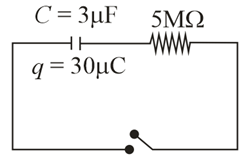
Correct Answer: 2
The capacitor is given an initial charge $$Q_0 = 30\,\mu\text{C}$$ and has capacitance $$C = 3\,\mu\text{F}$$.
Voltage-charge relation for a capacitor:
$$Q = C\,V$$
Hence the initial voltage across the capacitor is
$$V_0 = \frac{Q_0}{C} = \frac{30\,\mu\text{C}}{3\,\mu\text{F}} = 10\ \text{V}$$
At the instant $$t = 0$$ the key is closed. The voltage across a capacitor cannot change instantaneously, so the two plates still maintain the same $$10\ \text{V}$$ at that moment. Just after closing the switch, the charged capacitor therefore behaves like an ideal 10 V source connected to the resistive network.
The question asks for the current through the $$5\ \text{M}\Omega$$ resistor immediately after the switch is closed. Because no other circuit element has yet had time to alter the potential difference, the full $$10\ \text{V}$$ appears across this resistor.
Ohm’s law gives
$$I = \frac{V}{R} = \frac{10\ \text{V}}{5\ \text{M}\Omega}
= \frac{10}{5 \times 10^{6}}\ \text{A}
= 2 \times 10^{-6}\ \text{A}
= 2\ \mu\text{A}$$
Thus, $$x = 2$$ (nearest integer).
Answer: $$2$$
Was this solution helpful?
_1.webp)

Educational materials for JEE preparation

Ask our AI anything

AI can make mistakes. Please verify important information.
AI can make mistakes. Please verify important information.