
Join Our JEE Preparation Group
Prep with like-minded aspirants; Get access to free daily tests and study material.
Sign in
Please select an account to continue using cracku.in
↓ →
Join Our JEE Preparation Group
Prep with like-minded aspirants; Get access to free daily tests and study material.
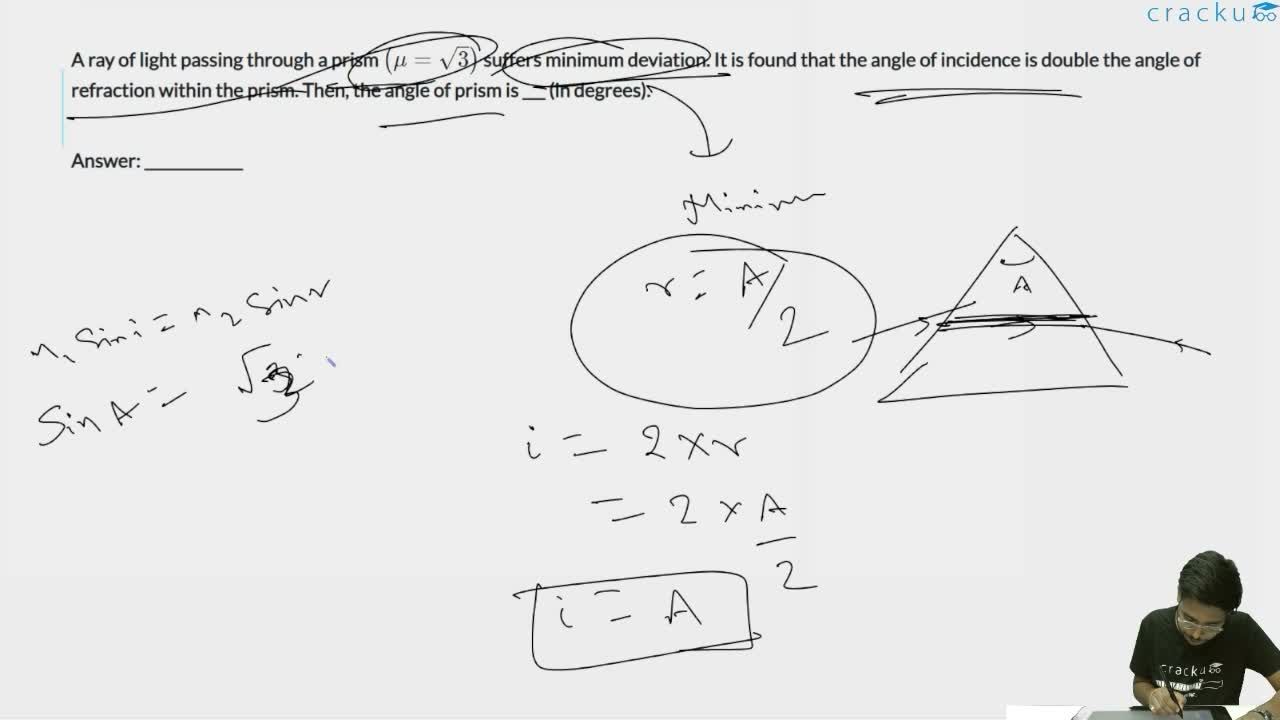
A ray of light passing through a prism $$\left(\mu = \sqrt{3}\right)$$ suffers minimum deviation. It is found that the angle of incidence is double the angle of refraction within the prism. Then, the angle of prism is ___ (in degrees).
Correct Answer: 60
At minimum deviation through a prism of angle $$A$$, the refracted ray inside the prism travels parallel to the base, and the angle of refraction inside the prism equals $$A/2$$. The angle of incidence at the first surface equals the angle of emergence at the second surface.
The problem states that the angle of incidence $$i$$ is double the angle of refraction $$r$$ inside the prism, i.e. $$i = 2r$$. Since at minimum deviation $$r = A/2$$, we have:
$$i = 2 \times \frac{A}{2} = A$$
Applying Snell's law at the first surface (air to prism):
$$\sin i = \mu \sin r$$
$$\sin A = \sqrt{3}\,\sin\!\left(\frac{A}{2}\right)$$
Using the identity $$\sin A = 2\sin(A/2)\cos(A/2)$$:
$$2\sin\!\left(\frac{A}{2}\right)\cos\!\left(\frac{A}{2}\right) = \sqrt{3}\,\sin\!\left(\frac{A}{2}\right)$$
Dividing both sides by $$\sin(A/2)$$ (non-zero):
$$2\cos\!\left(\frac{A}{2}\right) = \sqrt{3} \implies \cos\!\left(\frac{A}{2}\right) = \frac{\sqrt{3}}{2}$$
$$\frac{A}{2} = 30^\circ \implies A = 60^\circ$$
The angle of the prism is $$60^\circ$$.
Was this solution helpful?
Click on the Email ☝️ to Watch the Video Solution
Create a FREE account and get:
_1.webp)

Educational materials for JEE preparation

Ask our AI anything

AI can make mistakes. Please verify important information.
AI can make mistakes. Please verify important information.
