
Join Our JEE Preparation Group
Prep with like-minded aspirants; Get access to free daily tests and study material.
Sign in
Please select an account to continue using cracku.in
↓ →
Join Our JEE Preparation Group
Prep with like-minded aspirants; Get access to free daily tests and study material.
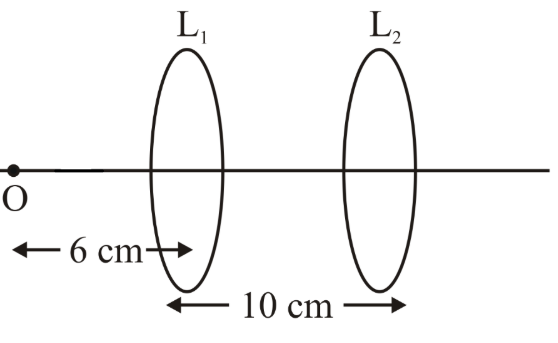
A point object O is placed in front of two thin symmetrical coaxial convex lenses $$L_1$$ and $$L_2$$ with focal length 24 cm and 9 cm respectively. The distance between two lenses is 10 cm and the object is placed 6 cm away from lens $$L_1$$ as shown in the figure. The distance between the object and the image formed by the system of two lenses is _______ cm.
Correct Answer: 34
We have two coaxial convex lenses: $$L_1$$ with focal length $$f_1 = 24$$ cm and $$L_2$$ with focal length $$f_2 = 9$$ cm, separated by 10 cm. An object is placed 6 cm from $$L_1$$, and we seek the distance between the object and the final image.
We apply the lens formula $$\dfrac{1}{v} - \dfrac{1}{u} = \dfrac{1}{f}$$ to the first lens, $$L_1$$. Here the object distance is $$u_1 = -6$$ cm (using the sign convention that left of the lens is negative) and the focal length is $$f_1 = 24$$ cm. Substituting these values gives $$\dfrac{1}{v_1} - \dfrac{1}{-6} = \dfrac{1}{24}$$, which simplifies to $$\dfrac{1}{v_1} + \dfrac{1}{6} = \dfrac{1}{24}$$. Therefore, $$\dfrac{1}{v_1} = \dfrac{1}{24} - \dfrac{1}{6} = \dfrac{1-4}{24} = \dfrac{-3}{24} = \dfrac{-1}{8}$$, giving $$v_1 = -8$$ cm. Hence the image formed by $$L_1$$ is 8 cm to the left of $$L_1$$ (a virtual image on the same side as the object).
Since the second lens $$L_2$$ is 10 cm to the right of $$L_1$$, this virtual image lies $$8 + 10 = 18$$ cm to the left of $$L_2$$ and thus acts as an object for $$L_2$$ with $$u_2 = -18$$ cm.
Applying the lens formula $$\dfrac{1}{v} - \dfrac{1}{u} = \dfrac{1}{f}$$ to $$L_2$$, we substitute $$u_2 = -18$$ cm and $$f_2 = 9$$ cm to obtain $$\dfrac{1}{v_2} - \dfrac{1}{-18} = \dfrac{1}{9}$$. This becomes $$\dfrac{1}{v_2} + \dfrac{1}{18} = \dfrac{1}{9}$$, so $$\dfrac{1}{v_2} = \dfrac{1}{9} - \dfrac{1}{18} = \dfrac{2-1}{18} = \dfrac{1}{18}$$, and hence $$v_2 = 18$$ cm. Consequently, the final image is 18 cm to the right of $$L_2$$.
Finally, since the object lies 6 cm to the left of $$L_1$$ and the final image lies 18 cm to the right of $$L_2$$, which itself is 10 cm to the right of $$L_1$$, the total separation between object and final image is $$6 + (10 + 18) = 6 + 28 = 34$$ cm. Thus the required distance is $$\boxed{34}$$ cm.
Was this solution helpful?
Create a FREE account and get:
_1.webp)

Educational materials for JEE preparation

Ask our AI anything

AI can make mistakes. Please verify important information.
AI can make mistakes. Please verify important information.


