
Join Our JEE Preparation Group
Prep with like-minded aspirants; Get access to free daily tests and study material.
Sign in
Please select an account to continue using cracku.in
↓ →
Join Our JEE Preparation Group
Prep with like-minded aspirants; Get access to free daily tests and study material.
The first three spectral lines of H-atom in the Balmer series are given $$\lambda_1, \lambda_2, \lambda_3$$ considering the Bohr atomic model, the wave lengths of first and third spectral lines $$\left(\frac{\lambda_1}{\lambda_3}\right)$$ are related by a factor of approximately $$x \times 10^{-1}$$. The value of $$x$$, to the nearest integer, is ________.
Correct Answer: 15
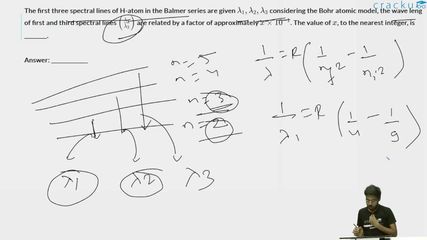
In the Balmer series, the spectral lines correspond to transitions from higher energy levels to $$n = 2$$. The wavelength for a transition from level $$n$$ to level 2 is given by $$\frac{1}{\lambda} = R\left(\frac{1}{2^2} - \frac{1}{n^2}\right)$$, where $$R$$ is the Rydberg constant.
For the first spectral line ($$\lambda_1$$), the transition is from $$n = 3$$ to $$n = 2$$: $$\frac{1}{\lambda_1} = R\left(\frac{1}{4} - \frac{1}{9}\right) = R \cdot \frac{5}{36}$$.
For the third spectral line ($$\lambda_3$$), the transition is from $$n = 5$$ to $$n = 2$$: $$\frac{1}{\lambda_3} = R\left(\frac{1}{4} - \frac{1}{25}\right) = R \cdot \frac{21}{100}$$.
Taking the ratio, $$\frac{\lambda_1}{\lambda_3} = \frac{21/100}{5/36} = \frac{21 \times 36}{100 \times 5} = \frac{756}{500} = 1.512$$.
This can be written as approximately $$15.12 \times 10^{-1}$$, so $$x \approx 15$$ to the nearest integer.
Was this solution helpful?
Click on the Email ☝️ to Watch the Video Solution
Create a FREE account and get:
_1.webp)

Educational materials for JEE preparation

Ask our AI anything

AI can make mistakes. Please verify important information.
AI can make mistakes. Please verify important information.
