
Join Our JEE Preparation Group
Prep with like-minded aspirants; Get access to free daily tests and study material.
Sign in
Please select an account to continue using cracku.in
↓ →
Join Our JEE Preparation Group
Prep with like-minded aspirants; Get access to free daily tests and study material.
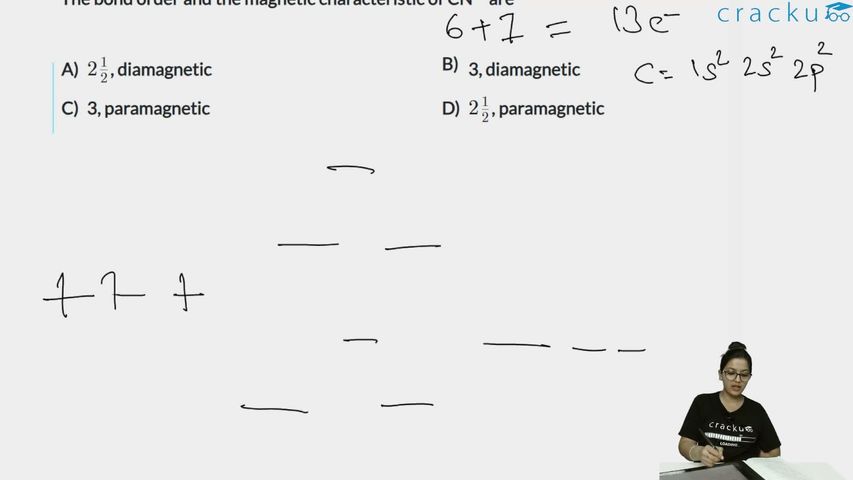
First, we find the total number of electrons present in the cyanide ion $$\text{CN}^-.$$
Carbon has atomic number 6, so it contributes $$6$$ electrons. Nitrogen has atomic number 7, so it contributes $$7$$ electrons. Because of the extra negative charge, the ion possesses one additional electron.
Hence the total electron count is $$6 + 7 + 1 \;=\; 14.$$
We now recall that a diatomic species with $$14$$ electrons is isoelectronic with the molecule $$\text{N}_2,$$ which also contains $$14$$ electrons. Therefore, $$\text{CN}^-$$ will have exactly the same pattern of molecular-orbital occupation as $$\text{N}_2.$$
For second-period diatomic molecules whose total atomic numbers are $$\le 14$$ (that is, up to nitrogen), the accepted energy order of molecular orbitals is $$\sigma_{1s},\;\sigma_{1s}^{*},\;\sigma_{2s},\;\sigma_{2s}^{*},\;\pi_{2p_x} = \pi_{2p_y},\;\sigma_{2p_z},\;\pi_{2p_x}^{*} = \pi_{2p_y}^{*},\;\sigma_{2p_z}^{*}.$$
We now place the $$14$$ electrons of $$\text{CN}^-$$ into these orbitals, filling from lower to higher energy and pairing spins whenever possible:
$$$\begin{aligned} \sigma_{1s}&^2 \\[-2pt] \sigma_{1s}^{*}&^2 \\[-2pt] \sigma_{2s}&^2 \\[-2pt] \sigma_{2s}^{*}&^2 \\[-2pt] \pi_{2p_x}&^2 \\[-2pt] \pi_{2p_y}&^2 \\[-2pt] \sigma_{2p_z}&^2 \end{aligned}$$$
All electrons are paired, so the species is diamagnetic.
To calculate bond order we use the standard formula
$$\text{Bond order} \;=\; \dfrac{N_b \;-\; N_a}{2},$$
where $$N_b$$ is the number of electrons in bonding molecular orbitals and $$N_a$$ is the number in antibonding molecular orbitals.
From the configuration we have
$$$\begin{aligned} N_b &= 2(\sigma_{1s}) + 2(\sigma_{2s}) + 4(\pi_{2p_x},\pi_{2p_y}) + 2(\sigma_{2p_z}) \;=\; 10,\\[4pt] N_a &= 2(\sigma_{1s}^{*}) + 2(\sigma_{2s}^{*}) \;=\; 4. \end{aligned}$$$
Substituting into the formula, we get
$$\text{Bond order} \;=\; \dfrac{10 - 4}{2} \;=\; \dfrac{6}{2} \;=\; 3.$$
Thus, $$\text{CN}^-$$ has a bond order of $$3$$ and is diamagnetic.
Hence, the correct answer is Option B.
Was this solution helpful?
Click on the Email ☝️ to Watch the Video Solution
Create a FREE account and get:
_1.webp)

Educational materials for JEE preparation

Ask our AI anything

AI can make mistakes. Please verify important information.
AI can make mistakes. Please verify important information.
