
Join Our JEE Preparation Group
Prep with like-minded aspirants; Get access to free daily tests and study material.
Sign in
Please select an account to continue using cracku.in
↓ →
Join Our JEE Preparation Group
Prep with like-minded aspirants; Get access to free daily tests and study material.
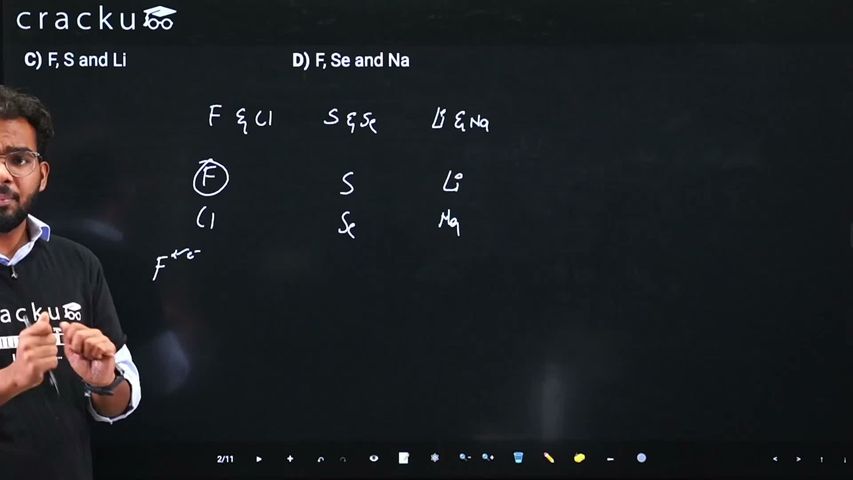
Within each pair of elements F and Cl, S and Se, and Li and Na, respectively, the elements that release more energy upon an electron gain are
For any atom in the gaseous state, the quantity of energy released when one electron is added is called its electron-gain enthalpy (also called electron affinity). A larger release of energy means a more negative value of $$\Delta_{\text{eg}}H$$ and therefore a stronger tendency to accept an electron.
General periodic trends help us decide which element of each pair shows the larger (more negative) $$\Delta_{\text{eg}}H$$ :
• Along a period from left to right, nuclear charge increases and size decreases, so electron-gain enthalpy usually becomes more negative.
• Down a group, atomic size increases and the added electron feels less attraction, so $$\Delta_{\text{eg}}H$$ usually becomes less negative. However, very small atoms of the second period (such as F, O, N) suffer noticeably from inter-electronic repulsion in their compact $$2p$$ orbitals, producing some well-known exceptions.
Now we compare each given pair.
First pair: $$\text{F}$$ and $$\text{Cl}$$ lie in Group 17. Although fluorine is above chlorine, its tiny $$2p$$ subshell is already crowded, so the incoming electron experiences appreciable repulsion. Therefore the energy released on adding an electron is actually less for F than for Cl. In numbers, $$\Delta_{\text{eg}}H(\text{F}) \approx -328\;\text{kJ mol}^{-1}$$ whereas $$\Delta_{\text{eg}}H(\text{Cl}) \approx -349\;\text{kJ mol}^{-1}$$. So chlorine releases more energy than fluorine.
Second pair: $$\text{S}$$ and $$\text{Se}$$ belong to Group 16. Moving down from sulfur to selenium the atomic size grows, and there is no exceptional crowding because the comparison is between $$3p$$ (for S) and $$4p$$ (for Se) orbitals. Consequently $$\Delta_{\text{eg}}H$$ becomes less negative down the group. Hence $$\Delta_{\text{eg}}H(\text{S})$$ is more negative than $$\Delta_{\text{eg}}H(\text{Se})$$, so sulfur releases more energy than selenium.
Third pair: $$\text{Li}$$ and $$\text{Na}$$ are the first two members of Group 1. For the alkali metals the usual down-the-group decrease in electron-gain enthalpy operates without any exceptions, because both $$\text{Li}$$ and $$\text{Na}$$ would place the extra electron into an $$s$$ orbital, and the size increase dominates. Numerically, $$\Delta_{\text{eg}}H(\text{Li}) \approx -60\;\text{kJ mol}^{-1}$$ while $$\Delta_{\text{eg}}H(\text{Na}) \approx -53\;\text{kJ mol}^{-1}$$. Therefore lithium releases more energy than sodium.
Collecting the conclusions: • Between F and Cl, the element releasing more energy is $$\text{Cl}$$. • Between S and Se, the element releasing more energy is $$\text{S}$$. • Between Li and Na, the element releasing more energy is $$\text{Li}$$.
Thus the required set is $$\text{Cl},\; \text{S},\; \text{Li}$$.
Hence, the correct answer is Option B.
Was this solution helpful?
Click on the Email ☝️ to Watch the Video Solution
Create a FREE account and get:
_1.webp)

Educational materials for JEE preparation

Ask our AI anything

AI can make mistakes. Please verify important information.
AI can make mistakes. Please verify important information.
