
Join Our JEE Preparation Group
Prep with like-minded aspirants; Get access to free daily tests and study material.
Sign in
Please select an account to continue using cracku.in
↓ →
Join Our JEE Preparation Group
Prep with like-minded aspirants; Get access to free daily tests and study material.
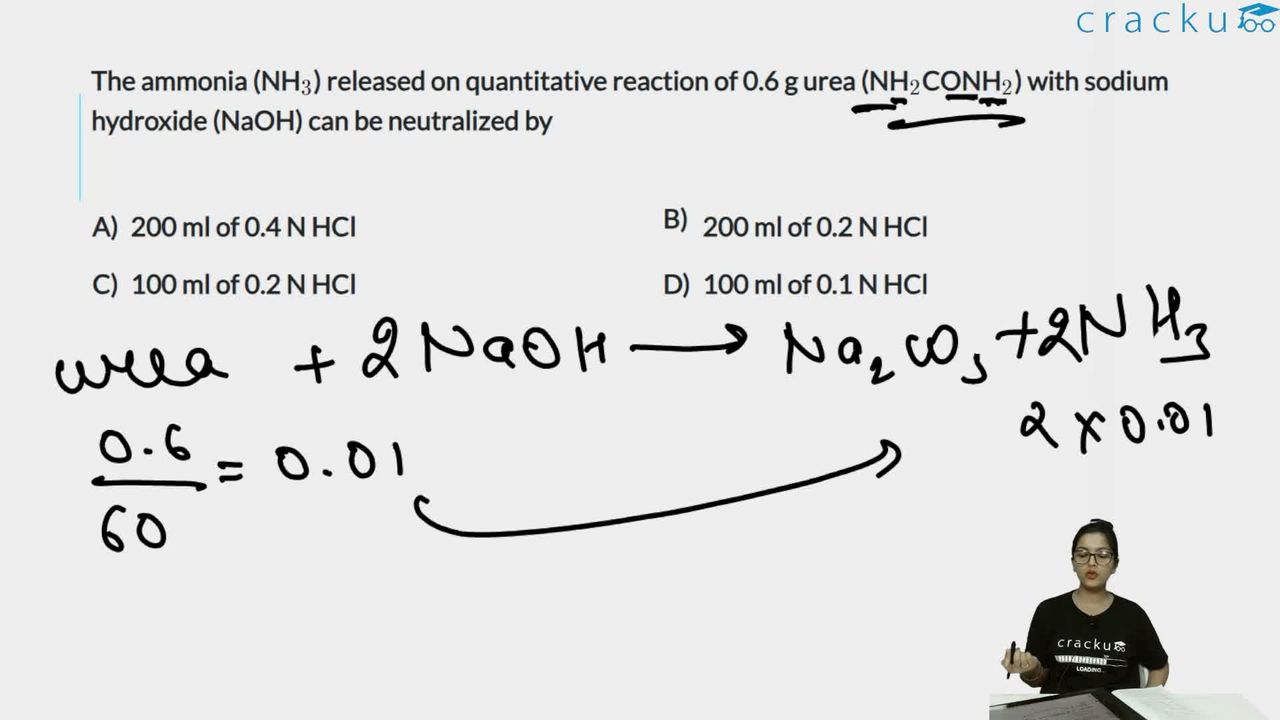
The ammonia (NH$$_3$$) released on quantitative reaction of 0.6 g urea (NH$$_2$$CONH$$_2$$) with sodium hydroxide (NaOH) can be neutralized by
First we recall the balanced chemical reaction between urea and aqueous sodium hydroxide, which furnishes ammonia as one of the products:
$$$\mathrm{NH_2CONH_2 + 2\,NaOH \;\longrightarrow\; Na_2CO_3 + 2\,NH_3}$$$
This equation tells us that
$$$1\;\text{mol urea} \;\xrightarrow{\phantom{2\,NaOH}}\; 2\;\text{mol NH}_3$$$
Now we calculate how many moles of urea are present in the given 0.6 g sample. The molar mass of urea is obtained by adding the individual atomic masses:
$$$M(\mathrm{NH_2CONH_2}) = 2\times14 \;(\text N) + 4\times1 \;(\text H) + 12 \;(\text C) + 16 \;(\text O) = 28 + 4 + 12 + 16 = 60\;\text{g mol}^{-1}$$$
Hence,
$$$n(\text{urea}) = \frac{m}{M} = \frac{0.6\;\text g}{60\;\text{g mol}^{-1}} = 0.01\;\text{mol}$$$
Using the stoichiometric ratio obtained earlier, the moles of ammonia liberated are
$$$n(\mathrm{NH_3}) = 2 \times n(\text{urea}) = 2 \times 0.01 = 0.02\;\text{mol}$$$
Next, ammonia is a base that reacts with hydrochloric acid according to the simple 1 : 1 neutralisation equation,
$$\mathrm{NH_3 + HCl \;\longrightarrow\; NH_4Cl}$$
Therefore, the number of moles (or equivalents, because HCl is monoprotic) of HCl needed equals the moles of NH$$_3$$ present:
$$n(\mathrm{HCl\;required}) = 0.02\;\text{mol}$$
Let us now examine each option by converting its volume and normality into moles of HCl supplied, using the relation $$n = N \times V$$ with $$V$$ in litres.
For Option A: $$$n = 0.4\;\text N \times 0.200\;\text L = 0.080\;\text{mol}$$$
For Option B: $$$n = 0.2\;\text N \times 0.200\;\text L = 0.040\;\text{mol}$$$
For Option C: $$$n = 0.2\;\text N \times 0.100\;\text L = 0.020\;\text{mol}$$$
For Option D: $$$n = 0.1\;\text N \times 0.100\;\text L = 0.010\;\text{mol}$$$
The requirement is 0.02 mol, and only Option C furnishes exactly this amount of acid.
Hence, the correct answer is Option C.
Was this solution helpful?
Click on the Email ☝️ to Watch the Video Solution
Create a FREE account and get:
_1.webp)

Educational materials for JEE preparation

Ask our AI anything

AI can make mistakes. Please verify important information.
AI can make mistakes. Please verify important information.
