
Join Our JEE Preparation Group
Prep with like-minded aspirants; Get access to free daily tests and study material.
Sign in
Please select an account to continue using cracku.in
↓ →
Join Our JEE Preparation Group
Prep with like-minded aspirants; Get access to free daily tests and study material.
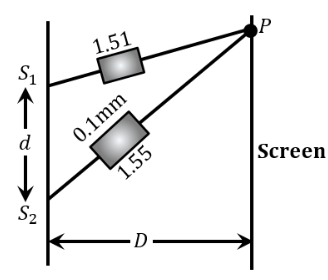
In Young's double slit experiment, two slits $$S_1$$ and $$S_2$$ are $$d$$ distance apart and the separation from slits to screen is $$D$$ (as shown in figure). Now if two transparent slabs of equal thickness $$0.1$$ mm but refractive index $$1.51$$ and $$1.55$$ are introduced in the path of beam $$\lambda = 4000$$ $$\text{\AA}$$ from $$S_1$$ and $$S_2$$ respectively. The central bright fringe spot will shift by ______ number of fringes.
Correct Answer: 10
In Young’s double slit experiment, transparent slabs of thickness $$t = 0.1$$ mm with refractive indices $$\mu_1 = 1.51$$ and $$\mu_2 = 1.55$$ are placed in front of slits $$S_1$$ and $$S_2$$ respectively. The path difference introduced by the slab at $$S_1$$ is $$(\mu_1 - 1)t$$, and that introduced by the slab at $$S_2$$ is $$(\mu_2 - 1)t$$. Consequently, the net extra path difference becomes $$\Delta = (\mu_2 - \mu_1)t = (1.55 - 1.51) \times 0.1 \times 10^{-3} = 0.04 \times 10^{-4} = 4 \times 10^{-6}$$ m.
Dividing this by the wavelength gives the fringe shift as $$\frac{\Delta}{\lambda} = \frac{4 \times 10^{-6}}{4000 \times 10^{-10}} = \frac{4 \times 10^{-6}}{4 \times 10^{-7}} = 10$$, so the central bright fringe shifts by $$\boxed{10}$$ fringes.
Was this solution helpful?
Create a FREE account and get:
_1.webp)

Educational materials for JEE preparation

Ask our AI anything

AI can make mistakes. Please verify important information.
AI can make mistakes. Please verify important information.


