
Join Our JEE Preparation Group
Prep with like-minded aspirants; Get access to free daily tests and study material.
Sign in
Please select an account to continue using cracku.in
↓ →
Join Our JEE Preparation Group
Prep with like-minded aspirants; Get access to free daily tests and study material.
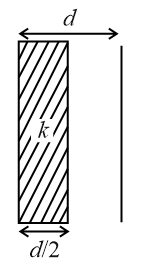
In a parallel plate capacitor set up, the plate area of capacitor is 2 m$$^2$$ and the plates are separated by 1 m. If the space between the plates are filled with a dielectric material of thickness 0.5 m and are 2 m$$^2$$ (see figure) the capacitance of the set-up will be $$\varepsilon_0$$ ________.
(Dielectric constant of the material = 3.2) (Round off to the Nearest Integer)
Correct Answer: 3
We need to find the total capacitance of a parallel plate capacitor setup where the space between the plates is partially filled with a dielectric material.
The total distance between the parallel plates is given as $$d = 1\text{ m}$$, and the area of the plates is $$A = 2\text{ m}^2$$.
A dielectric material with a dielectric constant $$K = 3.2$$ and a thickness of $$t = 0.5\text{ m}$$ is placed inside. This leaves an empty air gap of thickness $$d - t = 1 - 0.5 = 0.5\text{ m}$$.
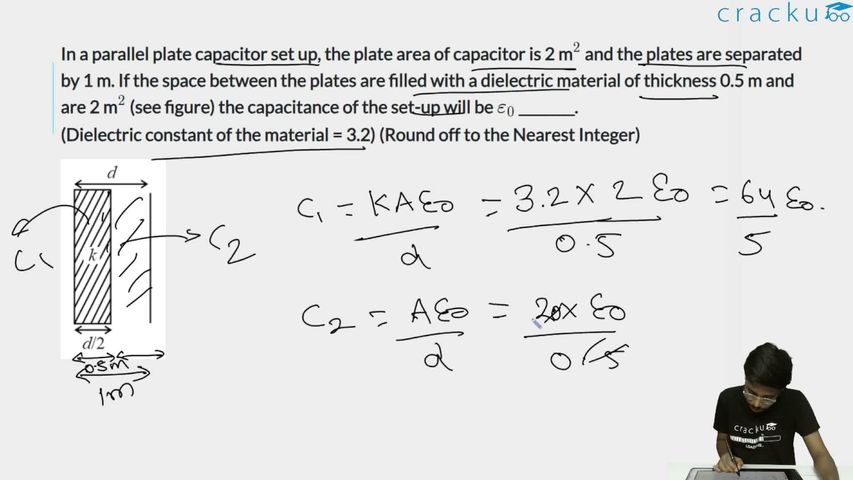
This setup can be modeled as two capacitors connected in series: one capacitor filled completely with the dielectric material ($$C_1$$) and another capacitor filled with air ($$C_2$$).
The capacitance of the dielectric-filled region is given by: $$C_1 = \frac{K \varepsilon_0 A}{t} = \frac{3.2 \times \varepsilon_0 \times 2}{0.5} = 12.8 \varepsilon_0$$.
The capacitance of the air-filled region is given by: $$C_2 = \frac{\varepsilon_0 A}{d - t} = \frac{\varepsilon_0 \times 2}{0.5} = 4 \varepsilon_0$$.
Since the two individual capacitances are in series, the equivalent total capacitance $$C_{eq}$$ is calculated using the series combination formula: $$\frac{1}{C_{eq}} = \frac{1}{C_1} + \frac{1}{C_2}$$.
Substituting the values into the formula yields: $$\frac{1}{C_{eq}} = \frac{1}{12.8 \varepsilon_0} + \frac{1}{4 \varepsilon_0} = \frac{1}{ \varepsilon_0} \left( \frac{1}{12.8} + \frac{1}{4} \right) = \frac{1}{ \varepsilon_0} \left( 0.078125 + 0.25 \right) = \frac{0.328125}{\varepsilon_0}$$.
Taking the reciprocal to find $$C_{eq}$$ gives: $$C_{eq} = \frac{\varepsilon_0}{0.328125} \approx 3.047 \varepsilon_0$$.
Rounding off to the nearest integer, the total capacitance of the set-up is given by $$3 \varepsilon_0$$.
Therefore, the correct integer answer is 3.
Was this solution helpful?
Click on the Email ☝️ to Watch the Video Solution
Create a FREE account and get:
_1.webp)

Educational materials for JEE preparation

Ask our AI anything

AI can make mistakes. Please verify important information.
AI can make mistakes. Please verify important information.
