
Join Our JEE Preparation Group
Prep with like-minded aspirants; Get access to free daily tests and study material.
Sign in
Please select an account to continue using cracku.in
↓ →
Join Our JEE Preparation Group
Prep with like-minded aspirants; Get access to free daily tests and study material.
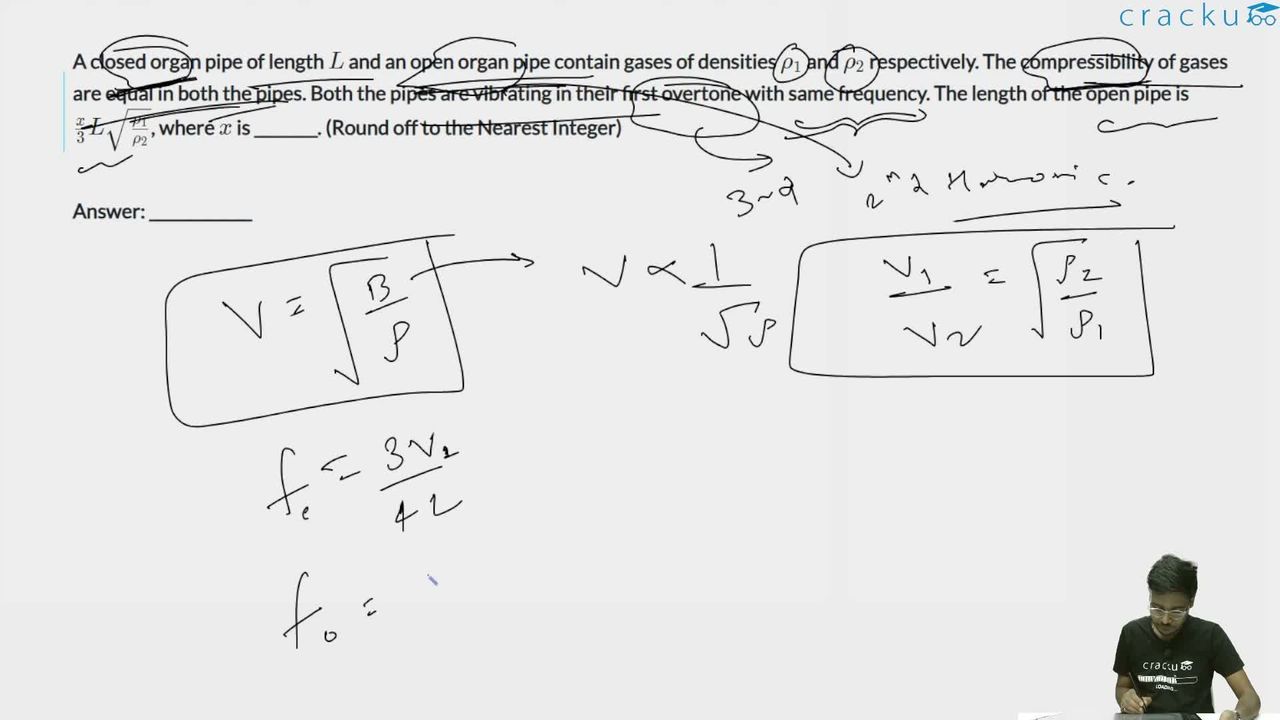
A closed organ pipe of length $$L$$ and an open organ pipe contain gases of densities $$\rho_1$$ and $$\rho_2$$ respectively. The compressibility of gases are equal in both the pipes. Both the pipes are vibrating in their first overtone with same frequency. The length of the open pipe is $$\frac{x}{3}L\sqrt{\frac{\rho_1}{\rho_2}}$$, where $$x$$ is ________. (Round off to the Nearest Integer)
Correct Answer: 4
The speed of sound in a gas is $$v = \sqrt{\frac{B}{\rho}}$$, where $$B$$ is the bulk modulus (inverse of compressibility) and $$\rho$$ is the density. Since compressibility is the same for both gases, $$B$$ is the same for both pipes.
For the closed organ pipe of length $$L$$, the first overtone (third harmonic) has frequency $$f_1 = \frac{3v_1}{4L}$$, where $$v_1 = \sqrt{\frac{B}{\rho_1}}$$.
For the open organ pipe of length $$L'$$, the first overtone (second harmonic) has frequency $$f_2 = \frac{2v_2}{2L'} = \frac{v_2}{L'}$$, where $$v_2 = \sqrt{\frac{B}{\rho_2}}$$.
Since both vibrate at the same frequency: $$\frac{3v_1}{4L} = \frac{v_2}{L'}$$.
Solving for $$L'$$: $$L' = \frac{4Lv_2}{3v_1} = \frac{4L}{3} \cdot \frac{\sqrt{B/\rho_2}}{\sqrt{B/\rho_1}} = \frac{4L}{3}\sqrt{\frac{\rho_1}{\rho_2}}$$.
Comparing with the given expression $$\frac{x}{3}L\sqrt{\frac{\rho_1}{\rho_2}}$$, we get $$x = 4$$.
The value of $$x$$ is $$\boxed{4}$$.
Click on the Email ☝️ to Watch the Video Solution
Create a FREE account and get:
_1.webp)

Educational materials for JEE preparation

Ask our AI anything

AI can make mistakes. Please verify important information.
AI can make mistakes. Please verify important information.


