
Join Our JEE Preparation Group
Prep with like-minded aspirants; Get access to free daily tests and study material.
Sign in
Please select an account to continue using cracku.in
↓ →
Join Our JEE Preparation Group
Prep with like-minded aspirants; Get access to free daily tests and study material.
A radioactive sample has an average life of 30 ms and is decaying. A capacitor of capacitance 200 $$\mu$$F is first charged and later connected with resistor $$R$$. If the ratio of the charge on the capacitor to the activity of the radioactive sample is fixed with respect to time then the value of $$R$$ should be _________ $$\Omega$$.
Correct Answer: 150
The activity $$A(t)$$ of a radioactive sample decreases exponentially:
$$A(t)=A_0\,e^{-\lambda t}$$
Here $$\lambda$$ is the decay constant. The average (mean) life $$\tau$$ of a nucleus is related by the formula $$\tau=\frac{1}{\lambda}\;$$ $$-(1)$$
For the given sample, $$\tau = 30\ \text{ms}=30\times10^{-3}\ \text{s}=0.03\ \text{s}$$.
Using $$(1)$$, $$\lambda = \frac{1}{\tau}=\frac{1}{0.03}\ \text{s}^{-1}=33.33\ \text{s}^{-1}$$.
After charging, the capacitor of capacitance $$C = 200\ \mu\text{F}=200\times10^{-6}\ \text{F}=2\times10^{-4}\ \text{F}$$ is allowed to discharge through a resistor $$R$$. The charge on the capacitor decays as
$$Q(t)=Q_0\,e^{-\frac{t}{RC}}$$ $$-(2)$$
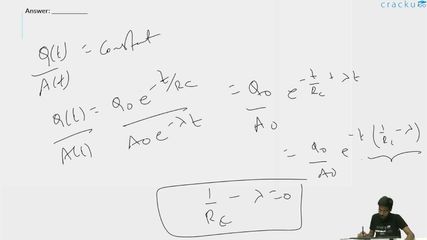
The problem states that the ratio $$\dfrac{Q(t)}{A(t)}$$ remains constant with time. Substituting $$A(t)$$ and $$Q(t)$$:
$$\frac{Q(t)}{A(t)}=\frac{Q_0\,e^{-\frac{t}{RC}}}{A_0\,e^{-\lambda t}}=\frac{Q_0}{A_0}\,e^{\,t\!\left(\lambda-\frac{1}{RC}\right)}$$ $$-(3)$$
For the right-hand factor $$e^{\,t(\lambda-\frac{1}{RC})}$$ to stay constant for every $$t$$, its exponent must be zero:
$$\lambda-\frac{1}{RC}=0\quad\Longrightarrow\quad RC=\frac{1}{\lambda}=\tau$$ $$-(4)$$
Using $$\tau = 0.03\ \text{s}$$ and $$C = 2\times10^{-4}\ \text{F}$$ in $$(4)$$:
$$R=\frac{\tau}{C}=\frac{0.03}{2\times10^{-4}}\ \Omega=150\ \Omega$$.
Therefore, the required resistance is 150 $$\Omega$$.
Was this solution helpful?
Click on the Email ☝️ to Watch the Video Solution
Create a FREE account and get:
_1.webp)

Educational materials for JEE preparation

Ask our AI anything

AI can make mistakes. Please verify important information.
AI can make mistakes. Please verify important information.
