
Join Our JEE Preparation Group
Prep with like-minded aspirants; Get access to free daily tests and study material.
Sign in
Please select an account to continue using cracku.in
↓ →
Join Our JEE Preparation Group
Prep with like-minded aspirants; Get access to free daily tests and study material.
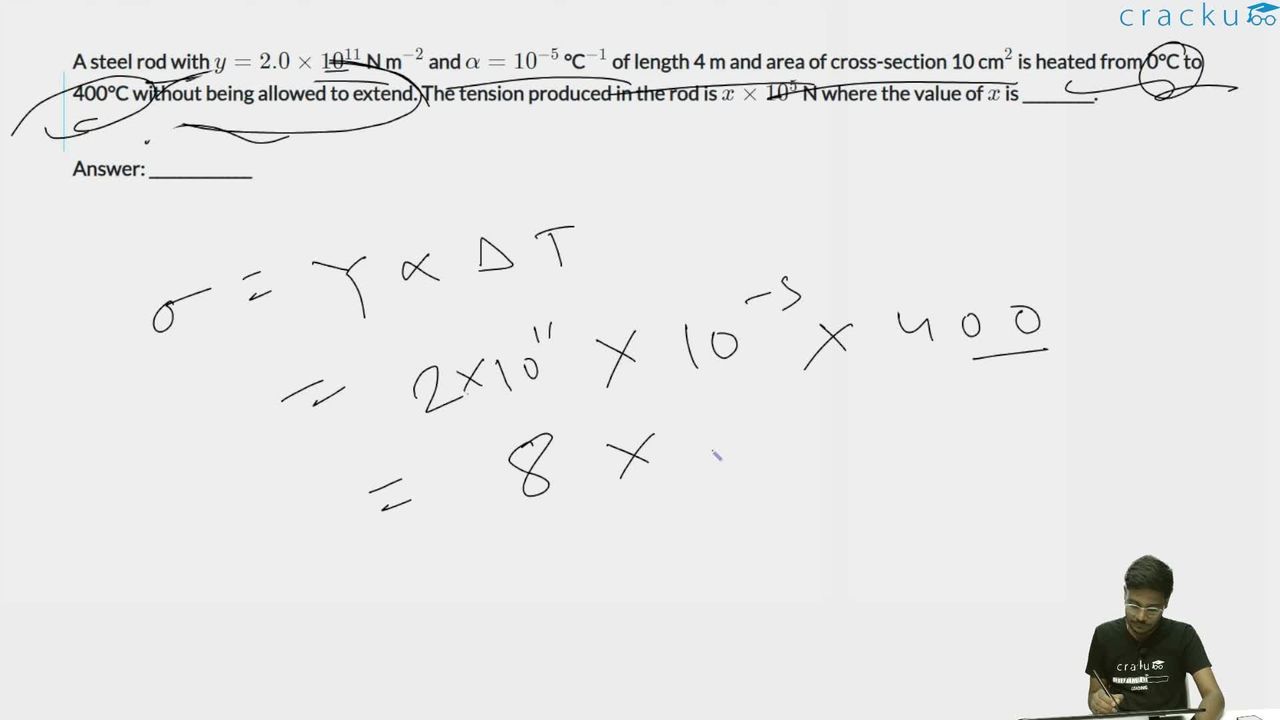
A steel rod with $$y = 2.0 \times 10^{11}$$ N m$$^{-2}$$ and $$\alpha = 10^{-5}$$ °C$$^{-1}$$ of length 4 m and area of cross-section 10 cm$$^2$$ is heated from 0°C to 400°C without being allowed to extend. The tension produced in the rod is $$x \times 10^5$$ N where the value of $$x$$ is _________.
Correct Answer: 8
We begin with the idea that, when a rod is heated but its length is not allowed to change, the thermal tendency to expand is opposed by an internal restoring force. The result is a thermal stress. For a uniform rod that is perfectly constrained, the magnitude of this stress is given by the well-known relation
$$\sigma = Y \, \alpha \, \Delta T,$$
where $$\sigma$$ is the stress, $$Y$$ is Young’s modulus, $$\alpha$$ is the coefficient of linear expansion, and $$\Delta T$$ is the change in temperature.
We have the numerical data: $$Y = 2.0 \times 10^{11}\, \text{N m}^{-2}, \quad \alpha = 10^{-5}\, ^\circ\text{C}^{-1}, \quad \Delta T = 400^\circ\text{C}.$$ Substituting these values,
$$\sigma = \left(2.0 \times 10^{11}\right)\!\left(10^{-5}\right)\!\left(400\right).$$
First multiply $$10^{-5}$$ and $$400$$:
$$10^{-5} \times 400 = 4 \times 10^{-3}.$$
Next multiply this result by $$2.0 \times 10^{11}$$:
$$\sigma = 2.0 \times 10^{11} \times 4 \times 10^{-3} = 8 \times 10^{8}\, \text{N m}^{-2}.$$
So the thermal stress inside the rod is $$\sigma = 8 \times 10^{8}\, \text{N m}^{-2}.$$
The tension (force) in the rod is obtained from the definition $$\sigma = F/A,$$ where $$A$$ is the cross-sectional area. Rearranging, $$F = \sigma A.$$ The given area is $$10 \text{ cm}^2.$$ Converting to square metres,
$$10 \text{ cm}^2 = 10 \times 10^{-4} \text{ m}^2 = 10^{-3} \text{ m}^2.$$
Now substitute $$\sigma = 8 \times 10^{8}\, \text{N m}^{-2}$$ and $$A = 10^{-3} \text{ m}^2$$ into $$F = \sigma A$$:
$$F = \left(8 \times 10^{8}\right) \left(10^{-3}\right) = 8 \times 10^{5}\, \text{N}.$$
The question states that this force can be written as $$x \times 10^{5}\, \text{N}.$$ Comparing, we see $$x = 8.$$
Hence, the correct answer is Option 8.
Click on the Email ☝️ to Watch the Video Solution
Create a FREE account and get:
_1.webp)

Educational materials for JEE preparation

Ask our AI anything

AI can make mistakes. Please verify important information.
AI can make mistakes. Please verify important information.


