
Join Our JEE Preparation Group
Prep with like-minded aspirants; Get access to free daily tests and study material.
Sign in
Please select an account to continue using cracku.in
↓ →
Join Our JEE Preparation Group
Prep with like-minded aspirants; Get access to free daily tests and study material.
A medium having dielectric constant $$K > 1$$ fills the space between the plates of a parallel plate capacitor. The plates have large area, and the distance between them is $$d$$. The capacitor is connected to a battery of voltage $$V$$, as shown in Figure (a). Now, both the plates are moved by a distance of $$\frac{d}{2}$$ from their original positions, as shown in Figure (b).
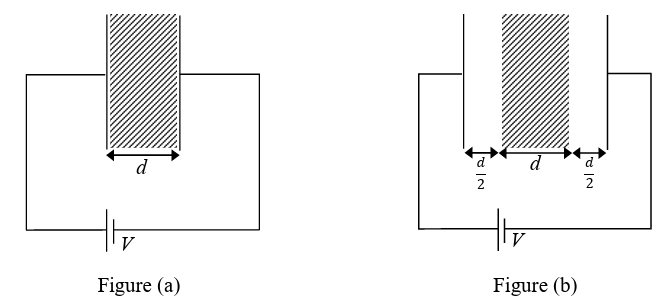
In the process of going from the configuration depicted in Figure (a) to that in Figure (b), which of the following statement(s) is(are) correct?
Let the area of each plate be $$A$$ (very large) and let the battery keep the potential difference between the plates fixed at $$V$$ throughout the entire process.
Initial configuration - Figure (a)
• Separation between plates = $$d$$.
• The whole region between the plates is filled with a dielectric of constant $$K$$.
Hence
Capacitance: $$C_i = \dfrac{\varepsilon_0 K A}{d}$$ $$-(1)$$
Electric field inside the dielectric:
Since the potential difference is $$V$$ and the field is uniform,
$$E_i = \dfrac{V}{d}$$ $$-(2)$$
Final configuration - Figure (b)
• Each plate is pulled away from its original position by $$\dfrac{d}{2}$$, so the new plate separation is
$$d + \dfrac{d}{2} + \dfrac{d}{2} = 2d$$.
• The dielectric slab remains where it was; its thickness is still $$d$$ and it now occupies the middle part of the gap.
Thus the space between the plates consists of three layers placed one after another (in series):
1. Vacuum of thickness $$\dfrac{d}{2}$$,
2. Dielectric of thickness $$d$$ and constant $$K$$,
3. Vacuum of thickness $$\dfrac{d}{2}$$.
Equivalent capacitance in the final set-up
For layers in series, the capacitance per unit area is found from
$$\dfrac{1}{C_f/A} = \dfrac{d_1}{\varepsilon_0} + \dfrac{d_2}{\varepsilon_0 K} + \dfrac{d_3}{\varepsilon_0}$$
Here
$$d_1 = d_3 = \dfrac{d}{2},\qquad d_2 = d$$.
Therefore
$$\dfrac{1}{C_f/A} = \dfrac{d/2}{\varepsilon_0} + \dfrac{d}{\varepsilon_0 K} + \dfrac{d/2}{\varepsilon_0} = \dfrac{d}{\varepsilon_0} + \dfrac{d}{\varepsilon_0 K} = \dfrac{d}{\varepsilon_0}\Bigl(1 + \dfrac{1}{K}\Bigr) = \dfrac{d}{\varepsilon_0}\,\dfrac{K+1}{K}$$
Hence
$$C_f = \dfrac{\varepsilon_0 A K}{d\,(K+1)}$$ $$-(3)$$
Comparison of capacitances
Using $$(1)$$ and $$(3)$$,
$$\dfrac{C_f}{C_i} = \dfrac{\varepsilon_0 A K}{d\,(K+1)} \bigg/ \dfrac{\varepsilon_0 K A}{d} = \dfrac{1}{K+1}$$
Thus the capacitance decreases by the factor $$\dfrac{1}{K+1}$$. Statement B is correct.
Electric fields in the final configuration
Let $$E_0$$ be the field in either vacuum gap and $$E_d$$ the field in the dielectric.
Because there is no free charge inside, the displacement field is continuous:
$$\varepsilon_0 E_0 = \varepsilon_0 K E_d \;\Longrightarrow\; E_0 = K E_d$$ $$-(4)$$
The total potential difference is still $$V$$ (battery connected):
$$V = E_0\Bigl(\dfrac{d}{2} + \dfrac{d}{2}\Bigr) + E_d (d) = dE_0 + dE_d = d\bigl(E_0 + E_d\bigr)$$
Using $$(4)$$, $$E_0 + E_d = K E_d + E_d = E_d (K+1)$$. Hence
$$E_d = \dfrac{V}{d\,(K+1)},\qquad E_0 = \dfrac{VK}{d\,(K+1)}$$
Comparing $$E_d$$ with the initial field $$E_i = \dfrac{V}{d}$$ (from $$(2)$$), we get $$\dfrac{E_d}{E_i} = \dfrac{1}{K+1}$$, not $$\dfrac{1}{2K}$$. Therefore Statement A is false.
Voltage between the plates
It remains fixed at $$V$$, so it is certainly not multiplied by $$(K+1)$$.
Statement C is false.
Work done
The energy stored initially: $$U_i = \dfrac{1}{2} C_i V^2$$.
The energy stored finally: $$U_f = \dfrac{1}{2} C_f V^2$$.
Because $$C_f \neq C_i$$ and depends on $$K$$, the work (equal to $$U_i - U_f$$, any difference being supplied by the battery) does depend on the dielectric.
Statement D is false.
Only Statement B is correct.
Option B which is: The capacitance is decreased by a factor of $$\dfrac{1}{K+1}$$.
Was this solution helpful?
Create a FREE account and get:
_1.webp)

Educational materials for JEE preparation

Ask our AI anything

AI can make mistakes. Please verify important information.
AI can make mistakes. Please verify important information.
