
Join Our JEE Preparation Group
Prep with like-minded aspirants; Get access to free daily tests and study material.
Sign in
Please select an account to continue using cracku.in
↓ →
Join Our JEE Preparation Group
Prep with like-minded aspirants; Get access to free daily tests and study material.
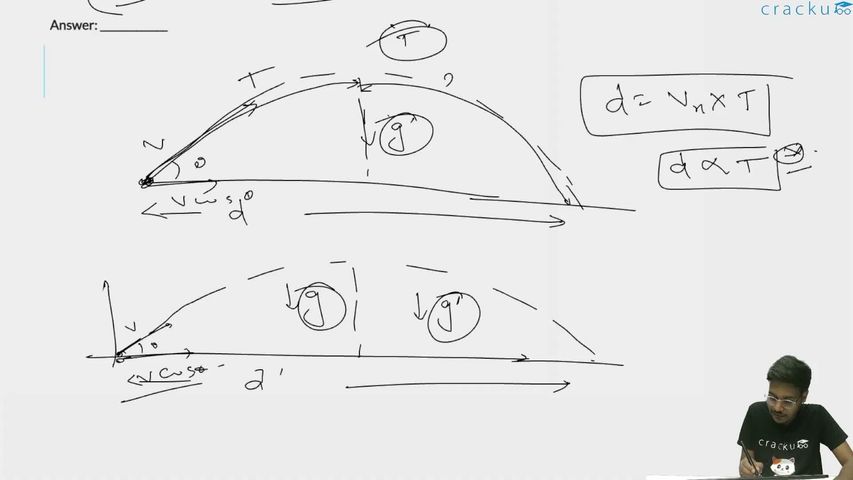
A projectile is fired from horizontal ground with speed $$v$$ and projection angle $$\theta$$. When the acceleration due to gravity is $$g$$, the range of the projectile is $$d$$. If at the highest point in its trajectory, the projectile enters a different region where the effective acceleration due to gravity is $$g' = \frac{g}{0.81}$$, then the new range is $$d' = nd$$. The value of $$n$$ is ______.
Correct Answer: 0.95
Let the projectile be launched with speed $$v$$ and angle of projection $$\theta$$ from a horizontal ground.
Horizontal component of velocity: $$v_x = v\cos\theta$$
Vertical component of velocity: $$v_y = v\sin\theta$$
Time to reach the highest point (region with acceleration $$g$$)
At the top, the vertical velocity becomes zero. Using the first equation of motion,
$$0 = v_y - gt_{\text{up}} \;\; \Longrightarrow \;\; t_{\text{up}} = \frac{v\sin\theta}{g}$$
Height of the highest point
Using $$v_y^{2} - u_y^{2} = 2g(h_{\text{max}} - 0)$$ with $$v_y = 0$$ and $$u_y = v\sin\theta$$:
$$0 - (v\sin\theta)^2 = -2gh_{\text{max}}$$
$$\Rightarrow h_{\text{max}} = \frac{v^{2}\sin^{2}\theta}{2g}$$
Descent in the region where acceleration is $$g' = \dfrac{g}{0.81}$$
From rest at the top, the projectile falls the height $$h_{\text{max}}$$ under acceleration $$g'$$.
Using $$h = \tfrac12 g' t_{\text{down}}^{2}$$:
$$\frac{v^{2}\sin^{2}\theta}{2g} = \frac12 g' t_{\text{down}}^{2}$$
$$\Longrightarrow t_{\text{down}} = \frac{v\sin\theta}{\sqrt{g\,g'}}$$
Total time of flight in the two-gravity situation
$$T' = t_{\text{up}} + t_{\text{down}} = \frac{v\sin\theta}{g} + \frac{v\sin\theta}{\sqrt{g\,g'}} = v\sin\theta\left(\frac1g + \frac1{\sqrt{g\,g'}}\right)$$
Horizontal range in the new situation
$$d' = v_x\,T' = v\cos\theta \, v\sin\theta\left(\frac1g + \frac1{\sqrt{g\,g'}}\right)$$
Original range (uniform gravity $$g$$)
$$d = v\cos\theta \times \frac{2v\sin\theta}{g} = \frac{v^{2}\sin2\theta}{g}$$
Ratio of the two ranges
$$n = \frac{d'}{d} = \frac{v\cos\theta\,v\sin\theta\left(\dfrac1g + \dfrac1{\sqrt{g\,g'}}\right)}{v\cos\theta \times \dfrac{2v\sin\theta}{g}} = \frac{\left(\dfrac1g + \dfrac1{\sqrt{g\,g'}}\right)}{\dfrac{2}{g}} = \frac12\left(1 + \sqrt{\frac{g}{g'}}\right)$$
Substituting $$g' = \dfrac{g}{0.81} \;\Longrightarrow\; \frac{g}{g'} = 0.81$$
$$\sqrt{\frac{g}{g'}} = \sqrt{0.81} = 0.9$$
Therefore, $$n = \frac12\bigl(1 + 0.9\bigr) = \frac{1.9}{2} = 0.95$$
The new range is $$d' = 0.95\,d$$. Hence, the required value of $$n$$ is 0.95.
Was this solution helpful?
Click on the Email ☝️ to Watch the Video Solution
Create a FREE account and get:
_1.webp)

Educational materials for JEE preparation

Ask our AI anything

AI can make mistakes. Please verify important information.
AI can make mistakes. Please verify important information.
