
Join Our JEE Preparation Group
Prep with like-minded aspirants; Get access to free daily tests and study material.
Sign in
Please select an account to continue using cracku.in
↓ →
Join Our JEE Preparation Group
Prep with like-minded aspirants; Get access to free daily tests and study material.
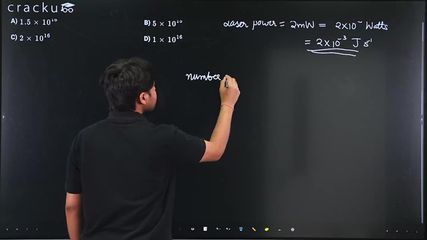
A 2 mW laser operates at a wavelength of 500 nm. The number of photons that will be emitted per second is:
[Given Planck's constant h = $$6.6 \times 10^{-34}$$ J s, speed of light c = $$3.0 \times 10^8$$ m/s]
We have been told that the laser gives a continuous power of $$P = 2 \text{ mW}$$.
First, let us convert this power into the SI unit watt:
$$P = 2 \text{ mW} = 2 \times 10^{-3}\,\text{W}.$$
A power of one watt means one joule of energy is delivered every second, so a power of $$P$$ watts means $$P$$ joules are emitted each second.
The energy carried by a single photon is found from Planck’s relation. We first state the formula:
$$E_{\text{photon}} = h\nu,$$
where $$h$$ is Planck’s constant and $$\nu$$ (nu) is the frequency of the light. Frequency and wavelength are connected through the speed of light $$c$$ by $$c = \lambda \nu$$, so $$\nu = \dfrac{c}{\lambda}$$. Substituting this into Planck’s relation gives an equivalent formula that uses the wavelength directly:
$$E_{\text{photon}} = \dfrac{h\,c}{\lambda}.$$
We now insert the numerical values. The wavelength is $$\lambda = 500\ \text{nm} = 500 \times 10^{-9}\,\text{m}.$$ The given constants are $$h = 6.6 \times 10^{-34}\,\text{J\,s}$$ and $$c = 3.0 \times 10^{8}\,\text{m/s}.$$ Substituting, we have
$$E_{\text{photon}} = \dfrac{(6.6 \times 10^{-34}\,\text{J\,s})(3.0 \times 10^{8}\,\text{m/s})} {500 \times 10^{-9}\,\text{m}}.$$
First multiply the numerator:
$$h\,c = (6.6 \times 10^{-34})(3.0 \times 10^{8}) = 19.8 \times 10^{-26}\,\text{J\,m}.$$
Now place this over the denominator:
$$E_{\text{photon}} = \dfrac{19.8 \times 10^{-26}} {500 \times 10^{-9}}\,\text{J}.$$
Rewrite $$19.8 = 1.98 \times 10^{1}$$ and $$500 = 5.00 \times 10^{2}$$ so that powers of ten are clearer:
$$E_{\text{photon}} = \dfrac{1.98 \times 10^{1} \times 10^{-26}} {5.00 \times 10^{2} \times 10^{-9}}\,\text{J}.$$
Combine powers of ten in the numerator and denominator: the denominator carries $$10^{2}\times10^{-9}=10^{-7}.$$ Hence,
$$E_{\text{photon}} = \dfrac{1.98 \times 10^{-25}}{5.00 \times 10^{-7}}\,\text{J}.$$
Dividing the coefficients and subtracting exponents gives
$$E_{\text{photon}} = \left(\dfrac{1.98}{5.00}\right)\times 10^{-25 + 7}\,\text{J} = 0.396 \times 10^{-18}\,\text{J}.$$
Shifting the decimal once to the right puts the coefficient between 1 and 10:
$$E_{\text{photon}} = 3.96 \times 10^{-19}\,\text{J}.$$
Now we know the energy released every second (the power) and the energy carried by each photon, so the number of photons emitted per second, $$N$$, is obtained by the simple ratio
$$N = \dfrac{\text{energy per second}}{\text{energy per photon}} = \dfrac{P}{E_{\text{photon}}}.$$
Substituting $$P = 2 \times 10^{-3}\,\text{J/s}$$ and $$E_{\text{photon}} = 3.96 \times 10^{-19}\,\text{J},$$ we get
$$N = \dfrac{2 \times 10^{-3}}{3.96 \times 10^{-19}} = \dfrac{2}{3.96}\times 10^{-3+19} = 0.505 \times 10^{16}.$$
One more shift of the decimal converts this to standard scientific notation:
$$N = 5.05 \times 10^{15}\,\text{photons per second}.$$
Rounding to one significant figure, as the options are, we have
$$N \approx 5 \times 10^{15}\,\text{photons per second}.$$
This value matches Option B in the list provided.
Hence, the correct answer is Option B.
Was this solution helpful?
Click on the Email ☝️ to Watch the Video Solution
Create a FREE account and get:
_1.webp)

Educational materials for JEE preparation

Ask our AI anything

AI can make mistakes. Please verify important information.
AI can make mistakes. Please verify important information.
