
Join Our JEE Preparation Group
Prep with like-minded aspirants; Get access to free daily tests and study material.
Sign in
Please select an account to continue using cracku.in
↓ →
Join Our JEE Preparation Group
Prep with like-minded aspirants; Get access to free daily tests and study material.
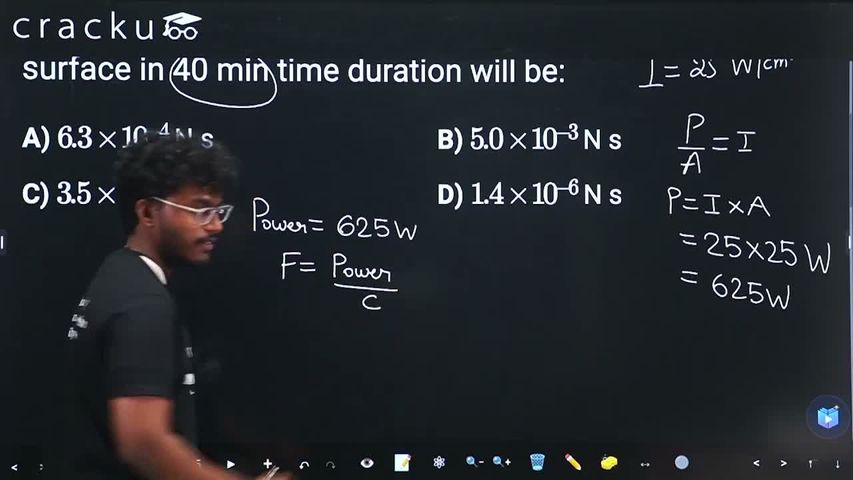
Light is incident normally on a completely absorbing surface with an energy flux of 25 W cm$$^{-2}$$. If the surface has an area of 25 cm$$^2$$, the momentum transferred to the surface in 40 min time duration will be:
We are told that light falls perpendicularly on a completely absorbing surface. The energy flux (intensity) of the light has the value
$$I = 25\;{\rm W\,cm^{-2}}.$$
First, recall the definition: intensity $$I$$ is the energy received per unit time per unit area, i.e.
$$I \;=\; \dfrac{\text{energy}}{\text{time}\times\text{area}}.$$
The illuminated surface has an area
$$A = 25\;{\rm cm^{2}}.$$
The power $$P$$ (total energy per unit time) incident on the whole surface is therefore obtained simply by multiplying the intensity by the area,
$$P = I\,A.$$
Substituting the given values, we find
$$P = 25\;{\rm W\,cm^{-2}}\;\times\;25\;{\rm cm^{2}} = 625\;{\rm W}.$$
Thus, $$625\;{\rm joules}$$ of radiant energy arrive every second.
The light shines for a time interval of
$$t = 40\;{\rm min}.$$
We convert minutes to seconds because SI calculations require seconds:
$$40\;{\rm min} = 40 \times 60\;{\rm s} = 2400\;{\rm s}.$$
The total energy $$E$$ arriving in this time is obtained from the relation $$E = P\,t$$:
$$E = 625\;{\rm W} \times 2400\;{\rm s}.$$
Doing the multiplication in steps, we note that
$$625 \times 24 = 15000,\quad$$ and adding the two extra zeros from $$2400$$
gives
$$E = 1.5 \times 10^{6}\;{\rm J}.$$
Now we have to relate this energy to the momentum delivered to the surface. For electromagnetic radiation the basic formula connecting energy $$E$$ and momentum $$p$$ is
$$p = \dfrac{E}{c},$$
where $$c$$ is the speed of light in vacuum,
$$c = 3.0 \times 10^{8}\;{\rm m\,s^{-1}}.$$
Because the surface completely absorbs the light, the entire momentum carried by the photons is transferred to the surface once and only once, so no factor of 2 is required. Therefore the momentum imparted $$\Delta p$$ equals $$E/c$$:
$$\Delta p = \dfrac{E}{c} = \dfrac{1.5 \times 10^{6}\;{\rm J}}{3.0 \times 10^{8}\;{\rm m\,s^{-1}}}.$$
Dividing the numbers, we proceed step by step:
$$\dfrac{1.5}{3.0} = 0.5,$$
and for the powers of ten
$$10^{6}/10^{8} = 10^{-2}.$$
Hence
$$\Delta p = 0.5 \times 10^{-2}\;{\rm N\,s}.$$
Finally we rewrite $$0.5 \times 10^{-2}$$ in standard scientific form:
$$0.5 \times 10^{-2} = 5.0 \times 10^{-3}\;{\rm N\,s}.$$
Hence, the correct answer is Option B.
Was this solution helpful?
Click on the Email ☝️ to Watch the Video Solution
Create a FREE account and get:
_1.webp)

Educational materials for JEE preparation

Ask our AI anything

AI can make mistakes. Please verify important information.
AI can make mistakes. Please verify important information.
