
Join Our JEE Preparation Group
Prep with like-minded aspirants; Get access to free daily tests and study material.
Sign in
Please select an account to continue using cracku.in
↓ →
Join Our JEE Preparation Group
Prep with like-minded aspirants; Get access to free daily tests and study material.
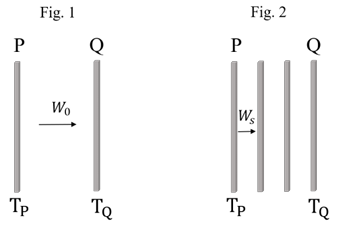
Two identical plates P and Q, radiating as perfect black bodies, are kept in vacuum at constant absolute temperatures $$T_P$$ and $$T_Q$$, respectively, with $$T_Q < T_P$$, as shown in Fig. 1. The radiated power transferred per unit area from P to Q is $$W_0$$. Subsequently, two more plates, identical to P and Q, are introduced between P and Q, as shown in Fig. 2. Assume that heat transfer takes place only between adjacent plates. If the power transferred per unit area in the direction from P to Q (Fig. 2) in the steady state is $$W_S$$, then the ratio $$\frac{W_0}{W_S}$$ is ________.
Correct Answer: 3
For a perfect black body the radiative power transferred per unit area between two surfaces at absolute temperatures $$T_1$$ and $$T_2$$ (with $$T_1 \gt T_2$$) is given by Stefan-Boltzmann law:
$$W = \sigma \left(T_1^{4} - T_2^{4}\right)$$
where $$\sigma$$ is the Stefan-Boltzmann constant.
Case 1: Only plates P and Q are present (Fig. 1).
The power per unit area flowing from P $$\rightarrow$$ Q is therefore
$$W_0 = \sigma\left(T_P^{4} - T_Q^{4}\right) \quad -(1)$$
Case 2: Two additional identical black plates are inserted between P and Q (Fig. 2). Let their steady-state temperatures be $$T_1$$ (next to P) and $$T_2$$ (next to Q), with $$T_P \gt T_1 \gt T_2 \gt T_Q$$. Heat exchange occurs only between adjacent plates, and in steady state the same power per unit area $$W_S$$ must flow across every gap.
Across the three gaps we have
$$W_S = \sigma\left(T_P^{4} - T_1^{4}\right)$$ $$W_S = \sigma\left(T_1^{4} - T_2^{4}\right)$$ $$W_S = \sigma\left(T_2^{4} - T_Q^{4}\right)$$
Divide each equation by $$\sigma$$ to write them purely in terms of temperature differences:
$$T_P^{4} - T_1^{4} = T_1^{4} - T_2^{4} = T_2^{4} - T_Q^{4} = \Delta \quad -(2)$$
Since the same quantity $$\Delta$$ appears three times, add the three equalities:
$$\left(T_P^{4} - T_1^{4}\right) + \left(T_1^{4} - T_2^{4}\right) + \left(T_2^{4} - T_Q^{4}\right) = 3\Delta$$
The middle terms cancel, leaving
$$T_P^{4} - T_Q^{4} = 3\Delta \quad -(3)$$
From $$(3)$$, $$\Delta = \dfrac{T_P^{4} - T_Q^{4}}{3}$$.
Substitute this $$\Delta$$ back into any expression for $$W_S$$ (say the first in $$(2)$$):
$$W_S = \sigma\Delta = \sigma \dfrac{T_P^{4} - T_Q^{4}}{3} = \dfrac{1}{3}\,\sigma\left(T_P^{4} - T_Q^{4}\right) \quad -(4)$$
Compare $$(1)$$ and $$(4)$$:
$$W_0 = \sigma\left(T_P^{4} - T_Q^{4}\right), \qquad W_S = \dfrac{1}{3}\,\sigma\left(T_P^{4} - T_Q^{4}\right)$$
Hence the required ratio is
$$\frac{W_0}{W_S} = \frac{\sigma\left(T_P^{4} - T_Q^{4}\right)}{\,\dfrac{1}{3}\,\sigma\left(T_P^{4} - T_Q^{4}\right)} = 3$$
Therefore, $$\dfrac{W_0}{W_S} = 3$$.
Create a FREE account and get:
_1.webp)

Educational materials for JEE preparation

Ask our AI anything

AI can make mistakes. Please verify important information.
AI can make mistakes. Please verify important information.


