
Join Our JEE Preparation Group
Prep with like-minded aspirants; Get access to free daily tests and study material.
Sign in
Please select an account to continue using cracku.in
↓ →
Join Our JEE Preparation Group
Prep with like-minded aspirants; Get access to free daily tests and study material.
Match the List-I with List II
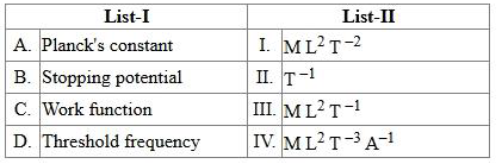
Choose the correct answer from the options given below:
We recall the basic facts of photo-electric effect:
• $$E = h\nu$$, where $$h$$ is Planck’s constant.
• Einstein’s equation $$h\nu = \phi + eV_s$$, where
$$\phi$$ = work function (minimum energy required to eject an electron),
$$V_s$$ = stopping potential, and
$$e$$ = magnitude of electronic charge.
• Threshold frequency $$\nu_0$$ satisfies $$h\nu_0 = \phi$$.
Let us evaluate the dimensions of each physical quantity.
Planck’s constant $$h$$
From $$E = h\nu$$ we have $$h = \dfrac{E}{\nu}$$.
Energy has dimensions $$[ML^2T^{-2}]$$ and frequency has $$[T^{-1}]$$.
Therefore
$$\left[h\right] = \dfrac{[ML^2T^{-2}]}{[T^{-1}]} = [ML^2T^{-1}]$$, which is set (III).
Stopping potential $$V_s$$
Potential (voltage) is work per unit charge: $$V = \dfrac{W}{Q}$$.
Work/energy has $$[ML^2T^{-2}]$$ and charge has $$[AT]$$ (since current $$I$$ has $$[A]$$ and $$Q = IT$$).
Hence
$$\left[V_s\right] = \dfrac{[ML^2T^{-2}]}{[AT]} = [ML^2T^{-3}A^{-1}]$$, which is set (IV).
Work function $$\phi$$
It is an energy, so
$$\left[\phi\right] = [ML^2T^{-2}]$$, which is set (I).
Threshold frequency $$\nu_0$$
Frequency is reciprocal of time, so
$$\left[\nu_0\right] = [T^{-1}]$$, which is set (II).
Collecting the matches:
A) Planck’s constant → (III) $$[ML^2T^{-1}]$$
B) Stopping potential → (IV) $$[ML^2T^{-3}A^{-1}]$$
C) Work function → (I) $$[ML^2T^{-2}]$$
D) Threshold frequency → (II) $$[T^{-1}]$$
This corresponds to Option A: A-III, B-IV, C-I, D-II.
Was this solution helpful?
Click on the Email ☝️ to Watch the Video Solution
Create a FREE account and get:
_1.webp)

Educational materials for JEE preparation

Ask our AI anything

AI can make mistakes. Please verify important information.
AI can make mistakes. Please verify important information.


