
Join Our JEE Preparation Group
Prep with like-minded aspirants; Get access to free daily tests and study material.
Sign in
Please select an account to continue using cracku.in
↓ →
Join Our JEE Preparation Group
Prep with like-minded aspirants; Get access to free daily tests and study material.
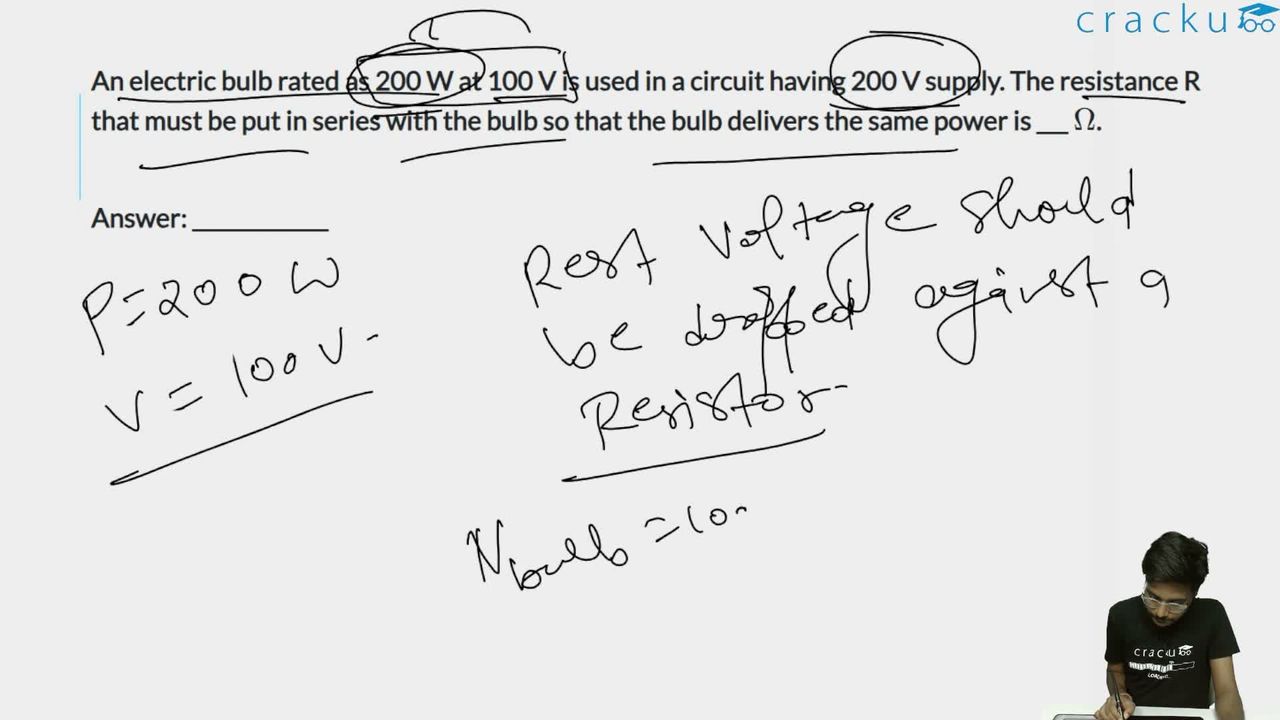
An electric bulb rated as 200 W at 100 V is used in a circuit having 200 V supply. The resistance R that must be put in series with the bulb so that the bulb delivers the same power is ___ $$\Omega$$.
Correct Answer: 50
We first recall the basic power-voltage-resistance relation for a purely resistive load: $$P=\dfrac{V^{2}}{R}\,.$$
The bulb is rated $$200\ \text{W}$$ at $$100\ \text{V}$$. Substituting these rated values in the above formula gives us its resistance:
$$R_{\text{bulb}}=\dfrac{V^{2}}{P}=\dfrac{(100\ \text{V})^{2}}{200\ \text{W}}=\dfrac{10000}{200}=50\ \Omega.$$
Thus the filament of the bulb behaves like a $$50\ \Omega$$ resistor when it is glowing at its rated conditions.
Now the circuit will be connected to a supply of $$200\ \text{V}$$, but we still want the bulb itself to have only its rated voltage of $$100\ \text{V}$$ across it so that it continues to deliver $$200\ \text{W}$$ of power. To find the current that must flow through the bulb under rated conditions, we use the power formula $$P=VI$$ (power equals voltage times current):
$$I=\dfrac{P}{V}=\dfrac{200\ \text{W}}{100\ \text{V}}=2\ \text{A}.$$
Therefore a current of $$2\ \text{A}$$ must flow through the bulb as well as through any series element we add.
Because the source voltage is $$200\ \text{V}$$ and the bulb needs only $$100\ \text{V}$$, the remaining voltage that must be dropped across the series resistor is
$$V_{\text{series}}=V_{\text{supply}}-V_{\text{bulb}}=200\ \text{V}-100\ \text{V}=100\ \text{V}.$$
Using Ohm’s law $$V=IR$$ for the series resistor, and noting that the same current $$2\ \text{A}$$ flows through it, we get
$$R_{\text{series}}=\dfrac{V_{\text{series}}}{I}=\dfrac{100\ \text{V}}{2\ \text{A}}=50\ \Omega.$$
So, the answer is $$50\ \Omega$$.
Was this solution helpful?
Click on the Email ☝️ to Watch the Video Solution
Create a FREE account and get:
_1.webp)

Educational materials for JEE preparation

Ask our AI anything

AI can make mistakes. Please verify important information.
AI can make mistakes. Please verify important information.
