
Join Our JEE Preparation Group
Prep with like-minded aspirants; Get access to free daily tests and study material.
Sign in
Please select an account to continue using cracku.in
↓ →
Join Our JEE Preparation Group
Prep with like-minded aspirants; Get access to free daily tests and study material.
A parallel plate capacitor with plate separation $$5$$ mm is charged up by a battery. It is found that on introducing a dielectric sheet of thickness $$2$$ mm, while keeping the battery connections intact, the capacitor draws $$25\%$$ more charge from the battery than before. The dielectric constant of the sheet is ____.
Correct Answer: 2
A parallel plate capacitor with plate separation $$d = 5$$ mm draws 25% more charge when a dielectric sheet of thickness $$t = 2$$ mm is introduced (with the battery connected). We need to find the dielectric constant $$K$$.
We start by writing the original capacitance.
$$ C_0 = \frac{\epsilon_0 A}{d} = \frac{\epsilon_0 A}{5} $$
(where the separation is in mm for now; the units will cancel)
Next, when a dielectric of thickness $$t$$ and dielectric constant $$K$$ is inserted, with the remaining gap being air, the effective capacitance is:
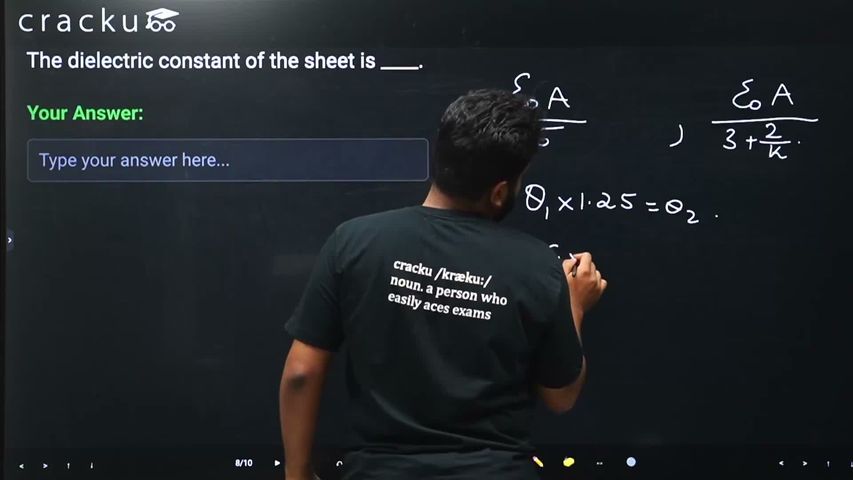
$$ C = \frac{\epsilon_0 A}{d - t + \frac{t}{K}} = \frac{\epsilon_0 A}{5 - 2 + \frac{2}{K}} = \frac{\epsilon_0 A}{3 + \frac{2}{K}} $$
This formula comes from treating the system as two capacitors in series (dielectric region and air region) and simplifying.
Since the battery remains connected, the voltage is constant and the charge follows $$Q = CV$$, so a 25% increase in charge means:
$$ C = 1.25 \times C_0 $$
$$ \frac{\epsilon_0 A}{3 + \frac{2}{K}} = 1.25 \times \frac{\epsilon_0 A}{5} $$
Cancelling $$\epsilon_0 A$$:
$$ \frac{1}{3 + \frac{2}{K}} = \frac{1.25}{5} = \frac{1}{4} $$
$$ 3 + \frac{2}{K} = 4 $$
$$ \frac{2}{K} = 1 $$
$$ K = 2 $$
The dielectric constant is $$\boxed{2}$$.
Was this solution helpful?
Click on the Email ☝️ to Watch the Video Solution
Create a FREE account and get:
_1.webp)

Educational materials for JEE preparation

Ask our AI anything

AI can make mistakes. Please verify important information.
AI can make mistakes. Please verify important information.
