
Join Our JEE Preparation Group
Prep with like-minded aspirants; Get access to free daily tests and study material.
Sign in
Please select an account to continue using cracku.in
↓ →
Join Our JEE Preparation Group
Prep with like-minded aspirants; Get access to free daily tests and study material.
Two waves are simultaneously passing through a string and their equations are:
$$y_1 = A_1 \sin k(x - vt)$$, $$y_2 = A_2 \sin k(x - vt + x_0)$$. Given amplitudes $$A_1 = 12$$ mm and $$A_2 = 5$$ mm, $$x_0 = 3.5$$ cm and wave number $$k = 6.28$$ cm$$^{-1}$$. The amplitude of resulting wave will be _________ mm.
Correct Answer: 7
We are given two progressive waves travelling through the same stretched string
$$y_1 = A_1 \sin k\,(x - v t)$$
$$y_2 = A_2 \sin k\,(x - v t + x_0)$$
with the numerical data
$$A_1 = 12 \text{ mm}, \qquad A_2 = 5 \text{ mm}, \qquad x_0 = 3.5 \text{ cm}, \qquad k = 6.28 \text{ cm}^{-1}.$$
Both waves have exactly the same angular wave number $$k$$ and hence the same angular frequency; the only difference between them is a phase difference produced by the extra term $$x_0$$ inside the argument of the second sine. To combine two sine waves of the same frequency but different amplitudes and phases, we use the standard superposition formula.
First we write the second wave so that the common factor $$k(x-vt)$$ is explicit:
$$y_2 = A_2 \sin\!\bigl[k(x-vt) + kx_0 \bigr].$$
This shows that the phase difference $$\phi$$ between the two waves is simply the quantity $$k x_0$$,
$$\phi = k x_0.$$
Let us compute this phase difference numerically. Both $$k$$ and $$x_0$$ are in centimetre units, so we may multiply directly:
$$\phi = k x_0 = (6.28 \,\text{cm}^{-1})(3.5 \,\text{cm}) = 21.98 \text{ rad}.$$
The number 21.98 rad is awkward, so we reduce it with the identity $$\cos(\theta + 2\pi n) = \cos\theta$$. Observe that
$$21.98 \text{ rad} \approx 6.28 \times 3.5 = 2\pi \times 3.5 = 7\pi.$$
Hence
$$\phi \approx 7\pi \text{ rad}.$$
Because $$\cos(7\pi) = \cos(\pi \times 7) = (-1)^7 = -1,$$ the exact cosine of the phase difference is
$$\cos\phi = -1.$$
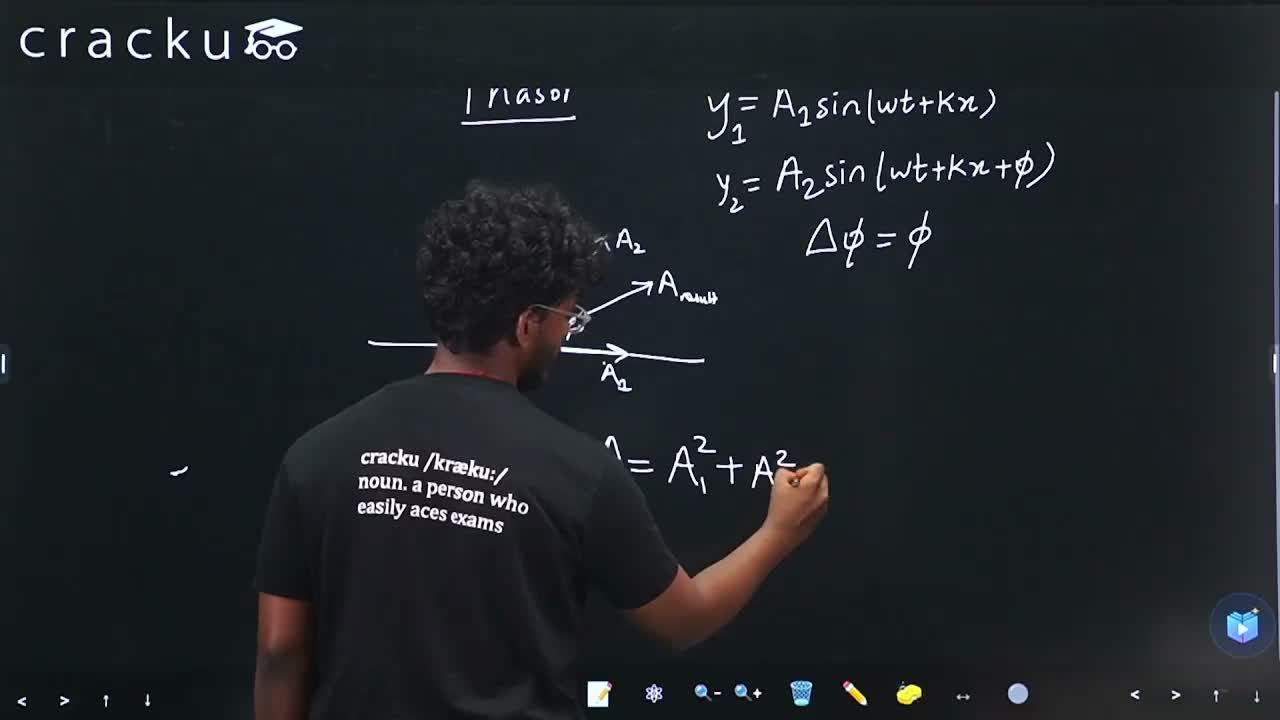
The resultant displacement $$y$$ is obtained by direct addition, $$y = y_1 + y_2$$, and it is again a sine function with the same angular factor $$k(x-vt)$$ but with a new amplitude $$A_R$$. The formula for the amplitude produced by adding two collinear simple harmonic motions of the same frequency is
$$A_R^2 = A_1^2 + A_2^2 + 2 A_1 A_2 \cos\phi.$$
We now substitute the known numbers:
$$A_R^2 = (12)^2 + (5)^2 + 2(12)(5)\cos\phi.$$
Since $$\cos\phi = -1$$, the last term becomes negative:
$$A_R^2 = 144 + 25 + 2(12)(5)(-1).$$
Compute each piece step by step:
$$144 + 25 = 169,$$
$$2(12)(5) = 120,$$
so
$$A_R^2 = 169 - 120 = 49.$$
Taking the positive square root gives the magnitude of the resultant amplitude:
$$A_R = \sqrt{49} = 7 \text{ mm}.$$
Hence, the correct answer is Option 7.
Was this solution helpful?
Click on the Email ☝️ to Watch the Video Solution
Create a FREE account and get:
_1.webp)

Educational materials for JEE preparation

Ask our AI anything

AI can make mistakes. Please verify important information.
AI can make mistakes. Please verify important information.
