
Join Our JEE Preparation Group
Prep with like-minded aspirants; Get access to free daily tests and study material.
Sign in
Please select an account to continue using cracku.in
↓ →
Join Our JEE Preparation Group
Prep with like-minded aspirants; Get access to free daily tests and study material.
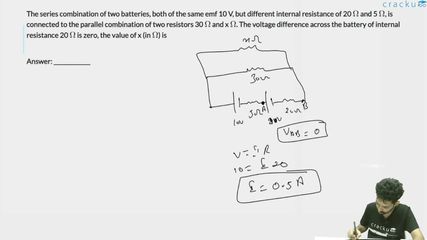
The series combination of two batteries, both of the same emf 10 V, but different internal resistance of 20 $$\Omega$$ and 5 $$\Omega$$, is connected to the parallel combination of two resistors 30 $$\Omega$$ and x $$\Omega$$. The voltage difference across the battery of internal resistance 20 $$\Omega$$ is zero, the value of x (in $$\Omega$$) is
Correct Answer: 30
We have two batteries connected in series. Each battery has emf $$E = 10\text{ V}$$, but their internal resistances are different: the first has $$r_{1} = 20\ \Omega$$ and the second has $$r_{2} = 5\ \Omega$$. Because they are in series, the total emf and the total internal resistance are obtained by simple addition:
$$E_{\text{total}} = E + E = 10 + 10 = 20\text{ V}$$
$$r_{\text{total}} = r_{1} + r_{2} = 20\ \Omega + 5\ \Omega = 25\ \Omega$$
The external circuit consists of two resistors, $$30\ \Omega$$ and $$x\ \Omega$$, connected in parallel. Their equivalent resistance is
$$R_{\text{eq}} \;=\; \dfrac{30\,x}{30 + x}\, \Omega$$
We are told that the potential difference across the battery whose internal resistance is $$20\ \Omega$$ is zero. The terminal voltage across any battery is given by the formula
$$V_{\text{terminal}} = E - I\,r$$
Setting this equal to zero for the battery with $$r = 20\ \Omega$$, we get
$$0 = 10\text{ V} - I\,(20\ \Omega)$$
$$I\,(20\ \Omega) = 10\text{ V}$$
$$I = \dfrac{10}{20} = 0.5\text{ A}$$
Thus, the current flowing through the entire series circuit must be exactly $$0.5\text{ A}$$.
Now we apply Ohm’s law to the complete circuit (emf in series with all resistances in the loop):
$$E_{\text{total}} \;=\; I \bigl(r_{\text{total}} + R_{\text{eq}}\bigr)$$
Substituting the known values,
$$20\text{ V} \;=\; 0.5\text{ A}\,\bigl(25\ \Omega + R_{\text{eq}}\bigr)$$
Dividing both sides by $$0.5\text{ A}$$,
$$\dfrac{20\text{ V}}{0.5\text{ A}} \;=\; 25\ \Omega + R_{\text{eq}}$$
$$40\ \Omega = 25\ \Omega + R_{\text{eq}}$$
$$R_{\text{eq}} = 40\ \Omega - 25\ \Omega = 15\ \Omega$$
But $$R_{\text{eq}}$$ is also equal to $$\dfrac{30x}{30 + x}$$, so we write
$$\dfrac{30x}{30 + x} = 15$$
Cross-multiplying gives
$$30x = 15\,(30 + x)$$
$$30x = 450 + 15x$$
$$30x - 15x = 450$$
$$15x = 450$$
$$x = \dfrac{450}{15} = 30\ \Omega$$
So, the answer is $$30\ \Omega$$.
Was this solution helpful?
Click on the Email ☝️ to Watch the Video Solution
Create a FREE account and get:
_1.webp)

Educational materials for JEE preparation

Ask our AI anything

AI can make mistakes. Please verify important information.
AI can make mistakes. Please verify important information.


