
Join Our JEE Preparation Group
Prep with like-minded aspirants; Get access to free daily tests and study material.
Sign in
Please select an account to continue using cracku.in
↓ →
Join Our JEE Preparation Group
Prep with like-minded aspirants; Get access to free daily tests and study material.
The first member of the Balmer series of hydrogen atom has a wavelength of 6561 $$\mathring{A}$$. The wavelength of the second member of the Balmer series (in nm) is
Correct Answer: 486
We have to find the wavelength of the second member of the Balmer series of the hydrogen atom, given that the first member has a wavelength of 6561 Å.
First, we convert the given wavelength from angstrom to nanometre because the final answer is required in nm. We know that
$$1\;\text{\AA}=0.1\;\text{nm}.$$
So,
$$\lambda_1 = 6561\;\text{\AA}=6561\times0.1\;\text{nm}=656.1\;\text{nm}.$$
For hydrogen spectral lines we use the Rydberg formula. We state it first:
$$\frac{1}{\lambda}=R\left(\frac{1}{n_1^2}-\frac{1}{n_2^2}\right),$$
where $$R$$ is the Rydberg constant, $$n_1$$ is the lower energy level and $$n_2$$ is the higher energy level with $$n_2>n_1$$.
In the Balmer series $$n_1=2$$ and $$n_2=3,4,5,\ldots$$
The first member (H-α line) corresponds to $$n_2=3$$. Therefore, using the given wavelength $$\lambda_1$$, we write
$$\frac{1}{\lambda_1}=R\left(\frac{1}{2^2}-\frac{1}{3^2}\right) =R\left(\frac{1}{4}-\frac{1}{9}\right).$$
Simplifying the bracket:
$$\frac{1}{4}=\frac{9}{36},\qquad \frac{1}{9}=\frac{4}{36},\qquad \frac{1}{4}-\frac{1}{9}=\frac{9}{36}-\frac{4}{36}=\frac{5}{36}.$$
So,
$$\frac{1}{\lambda_1}=R\left(\frac{5}{36}\right).$$
Re-arranging to obtain $$R$$, we get
$$R=\frac{1}{\lambda_1}\cdot\frac{36}{5}.$$
Now we move to the second member (H-β line) of the Balmer series, for which $$n_2=4$$. Again using the Rydberg formula:
$$\frac{1}{\lambda_2}=R\left(\frac{1}{2^2}-\frac{1}{4^2}\right) =R\left(\frac{1}{4}-\frac{1}{16}\right).$$
Simplifying inside the bracket:
$$\frac{1}{4}=\frac{4}{16},\qquad \frac{1}{16}=\frac{1}{16},\qquad \frac{1}{4}-\frac{1}{16}=\frac{4}{16}-\frac{1}{16}=\frac{3}{16}.$$
Hence,
$$\frac{1}{\lambda_2}=R\left(\frac{3}{16}\right).$$
Substituting the expression of $$R$$ obtained from the first line:
$$\frac{1}{\lambda_2}=\left(\frac{1}{\lambda_1}\cdot\frac{36}{5}\right)\left(\frac{3}{16}\right).$$
Multiplying the numerical factors:
$$\frac{36}{5}\times\frac{3}{16}=\frac{36\times3}{5\times16} =\frac{108}{80}=\frac{27}{20}.$$
Thus,
$$\frac{1}{\lambda_2}=\frac{1}{\lambda_1}\cdot\frac{27}{20}.$$
Taking the reciprocal of both sides to isolate $$\lambda_2$$:
$$\lambda_2=\lambda_1\cdot\frac{20}{27}.$$
Now we substitute $$\lambda_1=656.1\;\text{nm}$$:
$$\lambda_2=656.1\;\text{nm}\times\frac{20}{27}.$$
Carrying out the multiplication-division step by step:
$$\frac{20}{27}\approx0.740740\dots$$
$$\lambda_2=656.1\times0.740740\dots\;\text{nm}\approx486.0\;\text{nm}.$$
So, the wavelength of the second member of the Balmer series is $$486\;\text{nm}$$.
Hence, the correct answer is Option C.
Was this solution helpful?
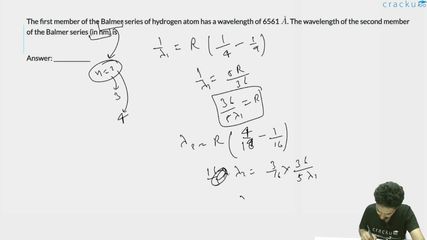
Click on the Email ☝️ to Watch the Video Solution
Create a FREE account and get:
_1.webp)

Educational materials for JEE preparation

Ask our AI anything

AI can make mistakes. Please verify important information.
AI can make mistakes. Please verify important information.


