
Join Our JEE Preparation Group
Prep with like-minded aspirants; Get access to free daily tests and study material.
Sign in
Please select an account to continue using cracku.in
↓ →
Join Our JEE Preparation Group
Prep with like-minded aspirants; Get access to free daily tests and study material.
Three containers $$C_1$$, $$C_2$$ and $$C_3$$ have water at different temperatures. The table below shows the final temperature T when different amounts of water (given in liters) are taken from each container and mixed (assume no loss of heat during the process)
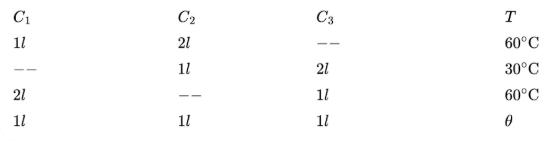
The value of $$\theta$$ (in $$^\circ$$C to the nearest integer) is__________
Correct Answer: 50
We begin by recalling the principle of calorimetry for ideal mixtures. When different masses (or, for a liquid of uniform density, different volumes) of water at temperatures $$T_1,\,T_2,\,T_3$$ are mixed and no heat is lost to the surroundings, the final equilibrium temperature is the weighted average:
$$T_{\text{final}}=\frac{m_1T_1+m_2T_2+m_3T_3}{m_1+m_2+m_3},$$
where $$m_1,m_2,m_3$$ are the respective masses or volumes. Here each litre of water is taken to have the same mass, so we may write all equations directly in litres.
Let the unknown temperatures of the three containers be
$$T_1\;(\text{for }C_1),\qquad T_2\;(\text{for }C_2),\qquad T_3\;(\text{for }C_3).$$
Now we translate every piece of experimental data into an equation.
First mixture: 1 L from $$C_1$$ and 2 L from $$C_2$$ are mixed, giving a final temperature of $$60^\circ\text{C}$$. Substituting in the formula,
$$\frac{1\cdot T_1+2\cdot T_2}{1+2}=60.$$
Multiplying both sides by 3, we obtain
$$T_1+2T_2=180 \quad -(1)$$
Second mixture: 1 L from $$C_2$$ and 2 L from $$C_3$$ are mixed, giving $$30^\circ\text{C}$$. Thus,
$$\frac{1\cdot T_2+2\cdot T_3}{1+2}=30,$$
which simplifies, after multiplying by 3, to
$$T_2+2T_3=90 \quad -(2)$$
Third mixture: 2 L from $$C_1$$ and 1 L from $$C_3$$ are mixed, again giving $$60^\circ\text{C}$$. Hence,
$$\frac{2\cdot T_1+1\cdot T_3}{2+1}=60,$$
and multiplying through by 3 yields
$$2T_1+T_3=180 \quad -(3)$$
We now have a system of three linear equations in the three unknowns $$T_1,T_2,T_3$$:
$$\begin{aligned} T_1+2T_2 &= 180\qquad&(1)\\ T_2+2T_3 &= 90\qquad&(2)\\ 2T_1+T_3 &= 180\qquad&(3) \end{aligned}$$
From equation (1) we solve for $$T_1$$ in terms of $$T_2$$:
$$T_1=180-2T_2. \quad -(4)$$
Substituting (4) in equation (3):
$$2(180-2T_2)+T_3=180.$$
Expanding the left side gives
$$360-4T_2+T_3=180.$$
Isolating $$T_3$$ we find
$$T_3=180+4T_2-360=4T_2-180. \quad -(5)$$
Now substitute (5) into equation (2):
$$T_2+2(4T_2-180)=90.$$
Simplifying the left-hand side,
$$T_2+8T_2-360=90,$$
which combines to
$$9T_2-360=90.$$
Adding 360 to both sides gives
$$9T_2=450,$$
and dividing by 9 yields
$$T_2=50^\circ\text{C}.$$
Back-substitution: Using $$T_2=50$$ in equation (4),
$$T_1=180-2(50)=180-100=80^\circ\text{C}.$$
Using $$T_2=50$$ in equation (5),
$$T_3=4(50)-180=200-180=20^\circ\text{C}.$$
So the individual container temperatures are
$$T_1=80^\circ\text{C},\qquad T_2=50^\circ\text{C},\qquad T_3=20^\circ\text{C}.$$
Finally, we turn to the required mixture of 1 L from each container. The total volume is $$1+1+1=3$$ litres, so
$$\theta=\frac{1\cdot T_1+1\cdot T_2+1\cdot T_3}{3} =\frac{80+50+20}{3} =\frac{150}{3} =50^\circ\text{C}.$$
So, the answer is $$50$$.
Was this solution helpful?
Create a FREE account and get:
_1.webp)

Educational materials for JEE preparation

Ask our AI anything

AI can make mistakes. Please verify important information.
AI can make mistakes. Please verify important information.


