
Join Our JEE Preparation Group
Prep with like-minded aspirants; Get access to free daily tests and study material.
Sign in
Please select an account to continue using cracku.in
↓ →
Join Our JEE Preparation Group
Prep with like-minded aspirants; Get access to free daily tests and study material.
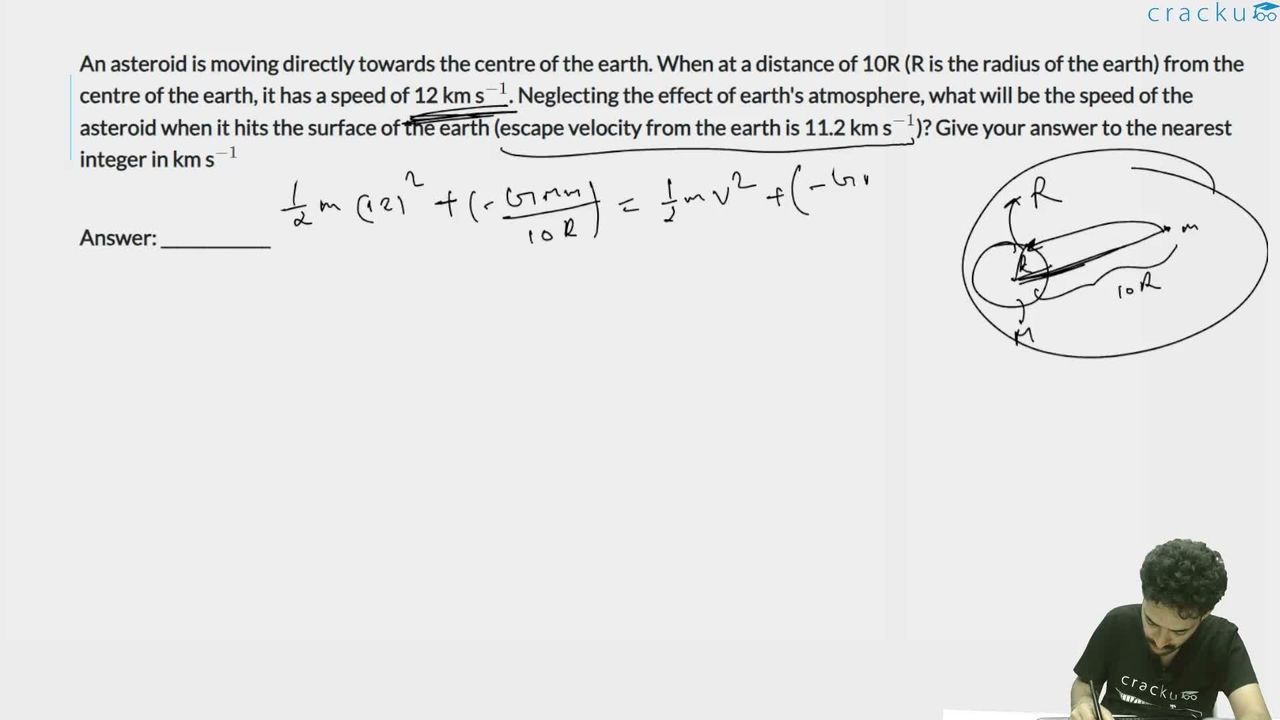
An asteroid is moving directly towards the centre of the earth. When at a distance of 10R (R is the radius of the earth) from the centre of the earth, it has a speed of 12 km s$$^{-1}$$. Neglecting the effect of earth's atmosphere, what will be the speed of the asteroid when it hits the surface of the earth (escape velocity from the earth is 11.2 km s$$^{-1}$$)? Give your answer to the nearest integer in km s$$^{-1}$$
Correct Answer: 16
We use conservation of mechanical energy, because the gravitational force is conservative and the atmosphere is neglected.
Let $$R$$ be the radius of the earth, $$M$$ its mass and $$G$$ the universal gravitational constant. The asteroid has
initial distance from the earth’s centre $$r_1 = 10R$$, initial speed $$v_1 = 12\ {\rm km\,s^{-1}}$$, final distance when it just touches the surface $$r_2 = R$$, and final speed $$v_2$$ (to be found).
The mechanical energy at any position is the sum of kinetic and gravitational potential energies. For a mass $$m$$ at a distance $$r$$ from the earth’s centre, the energies are
$$\text{K.E.} = \tfrac12 m v^2,\qquad \text{P.E.} = -\dfrac{G M m}{r}.$$
Conservation of energy gives
$$\tfrac12 m v_1^2 - \dfrac{G M m}{r_1} \;=\; \tfrac12 m v_2^2 - \dfrac{G M m}{r_2}.$$
Dividing by $$m$$ and multiplying by $$2$$ to remove the fractions, we get
$$v_1^2 - \dfrac{2GM}{r_1} \;=\; v_2^2 - \dfrac{2GM}{r_2}.$$
Re-arranging for $$v_2^2$$:
$$v_2^2 \;=\; v_1^2 - \dfrac{2GM}{r_1} + \dfrac{2GM}{r_2}.$$
Now substitute $$r_1 = 10R$$ and $$r_2 = R$$:
$$v_2^2 \;=\; v_1^2 - \dfrac{2GM}{10R} + \dfrac{2GM}{R}.$$
Combine the potential-energy terms:
$$-\dfrac{2GM}{10R} + \dfrac{2GM}{R} \;=\; \dfrac{2GM}{R}\Bigl(1 - \tfrac1{10}\Bigr) \;=\; \dfrac{2GM}{R}\,\dfrac{9}{10}.$$
Thus
$$v_2^2 \;=\; v_1^2 + \dfrac{9}{10}\,\dfrac{2GM}{R}.$$
The escape velocity from the earth is given in the question as $$11.2\ {\rm km\,s^{-1}}$$. By definition, escape velocity $$v_\text{esc}$$ satisfies
$$v_\text{esc} = \sqrt{\dfrac{2GM}{R}}.$$
Therefore
$$\dfrac{2GM}{R} = v_\text{esc}^{\,2} = (11.2)^2 = 125.44.$$
Insert this and $$v_1 = 12\ {\rm km\,s^{-1}}$$ into the expression for $$v_2^2$$:
$$v_2^2 = (12)^2 + \dfrac{9}{10}\,(125.44) = 144 + 0.9 \times 125.44 = 144 + 112.896 = 256.896.$$
Taking the square root,
$$v_2 = \sqrt{256.896}\ {\rm km\,s^{-1}} \;\approx\; 16.03\ {\rm km\,s^{-1}}.$$
Rounding to the nearest integer, the speed is $$16\ {\rm km\,s^{-1}}.$$
So, the answer is $$16\ {\rm km\,s^{-1}}.$$
Was this solution helpful?
Click on the Email ☝️ to Watch the Video Solution
Create a FREE account and get:
_1.webp)

Educational materials for JEE preparation

Ask our AI anything

AI can make mistakes. Please verify important information.
AI can make mistakes. Please verify important information.


