
Join Our JEE Preparation Group
Prep with like-minded aspirants; Get access to free daily tests and study material.
Sign in
Please select an account to continue using cracku.in
↓ →
Join Our JEE Preparation Group
Prep with like-minded aspirants; Get access to free daily tests and study material.
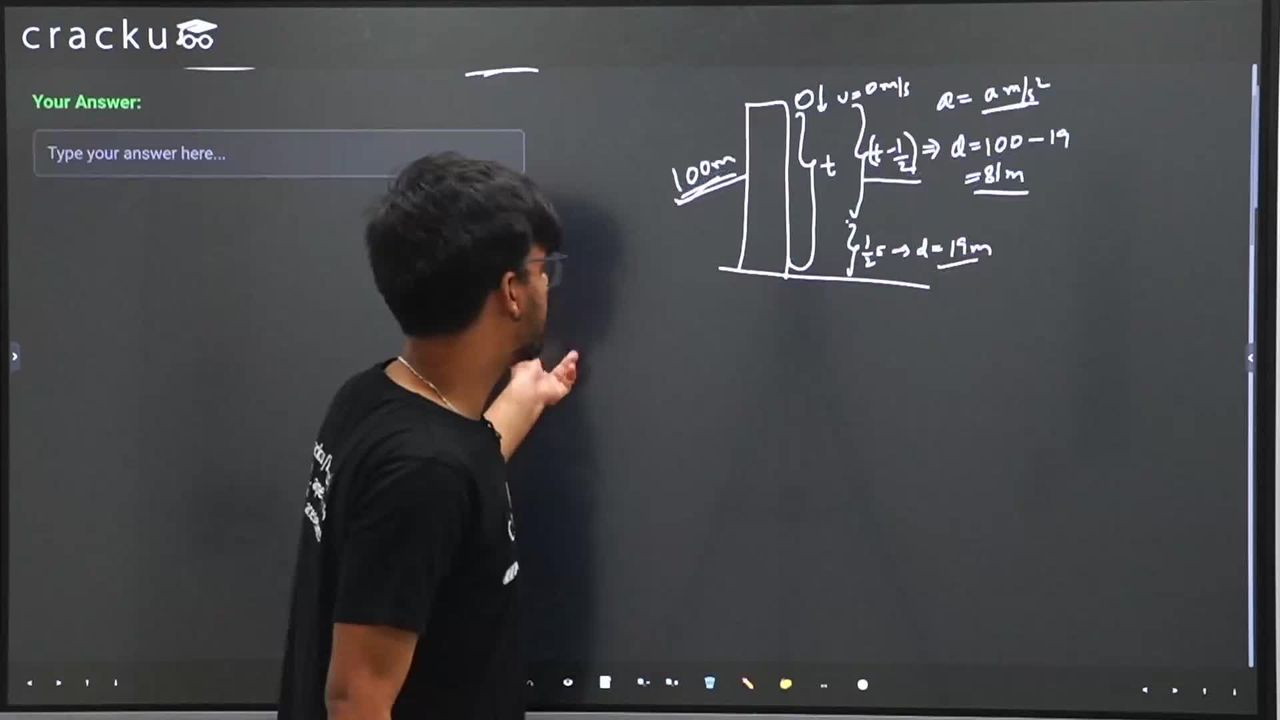
A ball is dropped from the top of a 100 m high tower on a planet. In the last $$\frac{1}{2}$$ s before hitting the ground, it covers a distance of 19 m. Acceleration due to gravity (in m s$$^{-2}$$) near the surface on that planet is
Correct Answer: 8
We start by letting the unknown acceleration due to gravity be $$g$$ (in m s$$^{-2}$$) and the total time taken by the ball to reach the ground be $$T$$ seconds. The ball is dropped from rest, so its initial velocity $$u=0$$.
For motion with constant acceleration we have the kinematic formula
$$s = uT + \dfrac{1}{2} g T^{2}.$$
Using this formula for the complete fall of $$100\ \text{m}$$, we write
$$100 = 0 \times T + \dfrac{1}{2}\,g\,T^{2},$$
which simplifies to
$$100 = \dfrac{1}{2} g T^{2}.$$
Multiplying both sides by 2 gives
$$g T^{2} = 200 \quad\Longrightarrow\quad T^{2} = \dfrac{200}{g}. \quad -(1)$$
Now, during the last $$\dfrac12$$ s before impact the ball covers only $$19\ \text{m}$$. Hence, in the preceding time interval $$T-0.5$$ seconds it must have covered the remaining distance of $$100-19 = 81\ \text{m}$$.
Applying the same kinematic formula for this first part of the motion, we get
$$81 = 0 \times (T-0.5) + \dfrac{1}{2}\,g\,(T-0.5)^{2},$$
or simply
$$81 = \dfrac{1}{2} g (T-0.5)^{2}. \quad -(2)$$
We expand the square:
$$(T-0.5)^{2} = T^{2} - 2 \times 0.5 \times T + (0.5)^{2} = T^{2} - T + 0.25.$$
Substituting this result into equation (2) gives
$$81 = \dfrac{1}{2} g \bigl(T^{2} - T + 0.25\bigr).$$
We already know from equation (1) that $$\dfrac{1}{2}gT^{2}=100$$, so we rewrite the right-hand side as
$$\dfrac12 g T^{2} - \dfrac12 g T + \dfrac12 g \times 0.25 = 100 - \dfrac12 g T + 0.125\,g.$$
Thus equation (2) becomes
$$81 = 100 - \dfrac12 g T + 0.125\,g.$$
Transposing terms, we have
$$-\dfrac12 g T + 0.125\,g = 81 - 100 = -19.$$
Multiplying by $$-1$$ gives a cleaner form:
$$\dfrac12 g T - 0.125\,g = 19.$$
Factoring out $$g$$ yields
$$g\left(\dfrac12 T - 0.125\right) = 19. \quad -(3)$$
From equation (3) we can express $$g$$ in terms of $$T$$:
$$g = \dfrac{19}{\dfrac12 T - 0.125} = \dfrac{19}{\dfrac{T-0.25}{2}} = \dfrac{38}{T - 0.25}. \quad -(4)$$
We also keep equation (1) in the equivalent form
$$g T^{2} = 200. \quad -(5)$$
Substituting the value of $$g$$ from (4) into (5), we get
$$\dfrac{38}{T - 0.25}\,T^{2} = 200.$$
Multiplying both sides by $$T-0.25$$ gives
$$38 T^{2} = 200\,(T - 0.25).$$
Dividing every term by 2 to simplify, we obtain
$$19 T^{2} = 100T - 25.$$
Rearranging all terms to one side provides a standard quadratic equation:
$$19 T^{2} - 100T + 25 = 0.$$
To solve for $$T$$ we calculate the discriminant:
$$\Delta = (-100)^{2} - 4 \times 19 \times 25
= 10000 - 1900
= 8100,$$
whose square root is $$\sqrt{8100} = 90.$$
Using the quadratic formula $$T = \dfrac{-b \pm \sqrt{\Delta}}{2a}$$ with $$a = 19,\ b = -100$$, we get
$$T = \dfrac{100 \pm 90}{2 \times 19} = \dfrac{100 \pm 90}{38}.$$
This yields two roots:
$$T_{1} = \dfrac{190}{38} = 5 \ \text{s}, \quad T_{2} = \dfrac{10}{38} \approx 0.263\ \text{s}.$$
The ball has to be in the air for more than $$0.5\ \text{s}$$ (because the question speaks of the last half-second), so the physically acceptable time is $$T = 5\ \text{s}.$$
Finally, substituting $$T = 5$$ into equation (4):
$$g = \dfrac{38}{5 - 0.25} = \dfrac{38}{4.75} = 8\ \text{m s}^{-2}.$$
So, the answer is $$8$$.
Was this solution helpful?
Click on the Email ☝️ to Watch the Video Solution
Create a FREE account and get:
_1.webp)

Educational materials for JEE preparation

Ask our AI anything

AI can make mistakes. Please verify important information.
AI can make mistakes. Please verify important information.


