
Join Our JEE Preparation Group
Prep with like-minded aspirants; Get access to free daily tests and study material.
Sign in
Please select an account to continue using cracku.in
↓ →
Join Our JEE Preparation Group
Prep with like-minded aspirants; Get access to free daily tests and study material.
A solid sphere of mass 1 kg and radius 1 m rolls without slipping on a fixed inclined plane with an angle of inclination $$\theta = 30^\circ$$ from the horizontal. Two forces of magnitude 1 N each, parallel to the incline, act on the sphere, both at distance $$r = 0.5$$ m from the center of the sphere, as shown in the figure. The acceleration of the sphere down the plane is ______ ms$$^{-2}$$. (Take $$g = 10$$ m s$$^{-2}$$.)
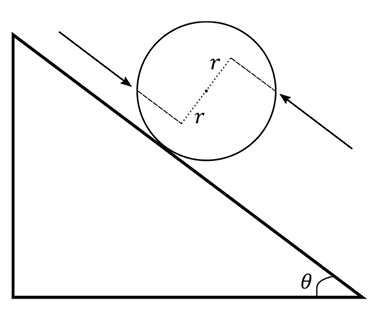
Correct Answer: 2.85-2.86
The sphere moves down the plane, so take the downward direction along the incline as positive for translation and the clockwise sense as positive for rotation.
Forces along the incline
• Weight component: $$mg\sin\theta = 1 \times 10 \times \sin 30^\circ = 5\,$$N (down the plane).
• Static friction $$f$$ acts up the plane (opposite the motion) to maintain rolling without slipping.
• Two equal forces of $$1\,$$N are applied. One is up the plane and the other is down the plane, so their net translational effect cancels: $$+1\,$$N - $$1\,$$N = 0. They therefore constitute a couple that produces only a torque.
Translational equation
Using Newton’s second law,
$$ma = mg\sin\theta - f$$
$$\Rightarrow\; a = 5 - f$$ $$-(1)$$
Torque equation about the centre
Moment of inertia of a solid sphere: $$I = \frac{2}{5}mR^{2} = \frac{2}{5}\times1\times1^{2} = 0.4\,$$kg m$$^{2}$$.
Rolling condition: $$a = \alpha R \Longrightarrow \alpha = a/R = a$$ because $$R = 1\,$$m.
Clockwise torques are taken positive.
• Torque due to friction: $$fR = f \times 1 = f$$ (clockwise, +).
• Torque due to the couple: each $$1\,$$N force acts at a perpendicular distance $$r = 0.5\,$m, giving a total anticlockwise torque
$$\tau_c = 2Fr = 2 $$\times$$ 1 $$\times$$ 0.5 = 1\,$$N m (anticlockwise, −).
Applying $$\sum$$\tau = I$$\alpha$$: $$f - 1 = I$$\alpha$$ = 0.4\,a$$ $$-(2)$$
Solve simultaneous equations
From $$(1):\; f = 5 - a$$.
Substitute in $$(2):$$
$$\bigl(5 - a\bigr) - 1 = 0.4\,a$$
$$4 - a = 0.4\,a$$
$$4 = 1.4\,a$$
$$a $$= $$\frac{4}{1.4} = \frac{20}{7}$$ $$\approx$$ 2.857 $$\text{ m\,s}^{-2}$$
Rounded to two decimal places, the acceleration of the sphere is $$\boxed{2.86$$\text{ m\,s}^{-2}}$$.
Create a FREE account and get:
_1.webp)

Educational materials for JEE preparation

Ask our AI anything

AI can make mistakes. Please verify important information.
AI can make mistakes. Please verify important information.


