
Join Our JEE Preparation Group
Prep with like-minded aspirants; Get access to free daily tests and study material.
Sign in
Please select an account to continue using cracku.in
↓ →
Join Our JEE Preparation Group
Prep with like-minded aspirants; Get access to free daily tests and study material.
A rectangular block of mass 5 kg attached to a horizontal spiral spring executes simple harmonic motion of amplitude 1 m and time period 3.14 s. The maximum force exerted by spring on block is _______ N.
Correct Answer: 20
We need to find the maximum force exerted by the spring on a block executing simple harmonic motion (SHM). Next, we note that the mass is $$m = 5$$ kg, the amplitude is $$A = 1$$ m, and the time period is $$T = 3.14$$ s.
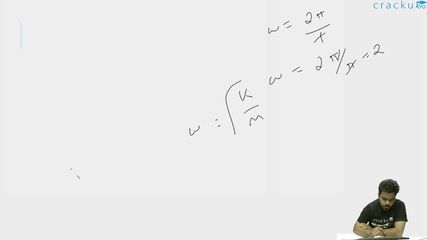
We begin by finding the angular frequency $$\omega$$. The angular frequency is related to the time period by:
$$\omega = \frac{2\pi}{T} = \frac{2\pi}{3.14} = \frac{2 \times 3.14}{3.14} = 2 \text{ rad/s}$$
Next, we find the spring constant $$k$$. For a mass-spring system executing SHM, the angular frequency is related to the spring constant and mass by:
$$\omega = \sqrt{\frac{k}{m}}$$
Squaring both sides: $$\omega^2 = \frac{k}{m}$$, so:
$$k = m\omega^2 = 5 \times (2)^2 = 5 \times 4 = 20 \text{ N/m}$$
Then, by Hooke's Law, the force exerted by the spring is $$F = kx$$, where $$x$$ is the displacement from the equilibrium position. The maximum force occurs at the maximum displacement, which is the amplitude $$A$$:
$$F_{max} = kA = 20 \times 1 = 20 \text{ N}$$
Therefore, the maximum force exerted by the spring on the block is 20 N.
Was this solution helpful?
Click on the Email ☝️ to Watch the Video Solution
Create a FREE account and get:
_1.webp)

Educational materials for JEE preparation

Ask our AI anything

AI can make mistakes. Please verify important information.
AI can make mistakes. Please verify important information.


