
Join Our JEE Preparation Group
Prep with like-minded aspirants; Get access to free daily tests and study material.
Sign in
Please select an account to continue using cracku.in
↓ →
Join Our JEE Preparation Group
Prep with like-minded aspirants; Get access to free daily tests and study material.
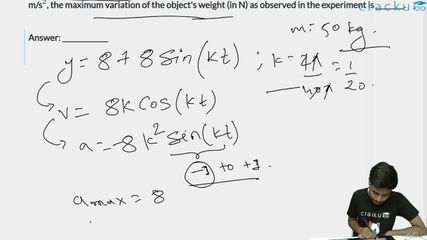
A person sitting inside an elevator performs a weighing experiment with an object of mass 50 kg. Suppose that the variation of the height $$y$$ (in m) of the elevator, from the ground, with time $$t$$ (in s) is given by $$y = 8\left[1 + \sin\left(\frac{2\pi t}{T}\right)\right]$$, where $$T = 40\pi$$ s. Taking acceleration due to gravity, $$g = 10$$ m/s$$^2$$, the maximum variation of the object's weight (in N) as observed in the experiment is ________.
Correct Answer: 2
The apparent (measured) weight inside an accelerating elevator equals the normal reaction $$N$$ on the object.
For upward acceleration $$a$$ (upward taken positive) the force equation is
$$N - mg = ma \; \Rightarrow \; N = m\,(g + a) \qquad -(1)$$
The elevator’s position as a function of time is given:
$$y = 8\left[1 + \sin\!\left(\frac{2\pi t}{T}\right)\right], \qquad T = 40\pi\;\text{s} \qquad -(2)$$
Differentiate twice to obtain the acceleration.
Angular frequency:
$$k = \frac{2\pi}{T} = \frac{2\pi}{40\pi} = \frac{1}{20}\;\text{s}^{-1}$$
Velocity:
$$v = \frac{dy}{dt} = 8\,k\,\cos(k t)$$
Acceleration:
$$a = \frac{dv}{dt} = -8\,k^{2}\,\sin(k t) \qquad -(3)$$
The sine term varies between $$+1$$ and $$-1$$, hence
Maximum upward acceleration (sin$$=-1$$):
$$a_{\max} = +8\,k^{2}$$
Maximum downward acceleration (sin$$=+1$$):
$$a_{\min} = -8\,k^{2}$$
Therefore the spread of acceleration values is
$$a_{\max} - a_{\min} = 8k^{2} - (-8k^{2}) = 16k^{2} \qquad -(4)$$
Insert $$k = 1/20$$:
$$k^{2} = \left(\frac{1}{20}\right)^{2} = \frac{1}{400}$$
$$16k^{2} = 16 \times \frac{1}{400} = \frac{16}{400} = 0.04\;\text{m\,s}^{-2}$$
Mass of the object: $$m = 50\;\text{kg}$$.
Using $$-(1)$$, the spread in the normal reaction (apparent weight) equals $$m$$ times the acceleration spread:
$$\Delta N = m\,(a_{\max} - a_{\min}) = 50 \times 0.04 = 2\;\text{N}$$
Hence, the maximum variation in the weight reading is
2 N.
Was this solution helpful?
Click on the Email ☝️ to Watch the Video Solution
Create a FREE account and get:
_1.webp)

Educational materials for JEE preparation

Ask our AI anything

AI can make mistakes. Please verify important information.
AI can make mistakes. Please verify important information.
