
Join Our JEE Preparation Group
Prep with like-minded aspirants; Get access to free daily tests and study material.
Sign in
Please select an account to continue using cracku.in
↓ →
Join Our JEE Preparation Group
Prep with like-minded aspirants; Get access to free daily tests and study material.
A monochromatic light wave is incident normally on a glass slab of thickness d, as shown in the figure. The refractive index of the slab increases linearly from $$n_1$$ to $$n_2$$ over the height h. Which of the following statement(s) is (are) true about the light wave emerging out of the slab?
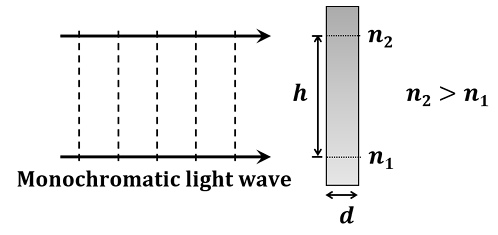
Let the lower face of the slab be taken as the reference (height $$y = 0$$) and the upper face be at $$y = h$$. The refractive index varies linearly with the height, so we write
$$n(y)=n_1+\left(\dfrac{n_2-n_1}{h}\right)\,y\qquad 0\le y\le h$$
Because the incident wave is normal to the slab, every ray travels the same geometrical length $$d$$ inside the glass. However, owing to the variation of $$n(y)$$, different rays accumulate different phases (or optical paths) inside the slab. For a ray that enters the slab at a height $$y$$, the optical path (OP) inside the glass is
$$\text{OP}(y)=n(y)\,d$$
The emerging beam will become a plane wave only when the phase difference produced inside the glass is exactly compensated by the geometrical path difference produced in air because of the deflection. Suppose the emergent beam makes a small angle $$\theta$$ (measured from the original direction, i.e. the normal to the slab). For two rays separated by a vertical distance $$\Delta y$$ at the exit surface, the extra geometrical distance travelled in air is $$\Delta y\,\tan\theta\;(\approx\Delta y\,\theta)$$. Hence, to obtain a single plane wave after the slab we must have
$$n(y)\,d+\;\Delta y\,\tan\theta=\text{constant}$$
Differentiating with respect to $$y$$ gives the required condition for compensation:
$$\dfrac{d}{dy}\Big[n(y)\,d\Big]+\,\tan\theta=0 \;\;\Longrightarrow\;\; \theta=\;d\;\dfrac{dn}{dy}$$ $$-(1)$$
Using the linear variation of $$n$$, $$\dfrac{dn}{dy}= \dfrac{n_2-n_1}{h}$$. Substituting this in $$(1)$$ gives
$$\theta=\dfrac{d\,(n_2-n_1)}{h}$$
The slab as a whole therefore behaves like a very thin prism of small apex angle $$A=\dfrac{d\,(n_2-n_1)}{h}$$. For a thin prism, the angular deviation $$\delta$$ produced when light emerges into air is given by the well-known formula
$$\delta=\mu_{\text{mean}}\;A,\qquad \mu_{\text{mean}}=\dfrac{n_1+n_2}{2}$$
Hence
$$\delta =\left(\dfrac{n_1+n_2}{2}\right)\left[\dfrac{d\,(n_2-n_1)}{h}\right] =\dfrac{(n_2^2-n_1^2)\,d}{2h}$$
Because the angles involved are small, $$\delta\approx\tan\delta$$, so the emergent beam is deflected upward by
$$\boxed{\; \tan^{-1}\!\left[\dfrac{(n_2^2-n_1^2)\,d}{2h}\right]\;}$$
This matches the expression given in Option A. Option B gives only $$\dfrac{(n_2-n_1)d}{h}$$ (missing the factor $$\dfrac{n_1+n_2}{2}$$), Option C is incorrect because a finite gradient always deflects the beam, and Option D is incorrect since the deflection also depends on the individual values of $$n_1$$ and $$n_2$$ through the factor $$\dfrac{n_1+n_2}{2}$$.
Therefore, the correct statement is:
Option A which is: It will deflect up by an angle $$\tan^{-1}\!\left[\dfrac{(n_2^2-n_1^2)\,d}{2h}\right]$$
Was this solution helpful?
Create a FREE account and get:
_1.webp)

Educational materials for JEE preparation

Ask our AI anything

AI can make mistakes. Please verify important information.
AI can make mistakes. Please verify important information.
