
Join Our JEE Preparation Group
Prep with like-minded aspirants; Get access to free daily tests and study material.
Sign in
Please select an account to continue using cracku.in
↓ →
Join Our JEE Preparation Group
Prep with like-minded aspirants; Get access to free daily tests and study material.
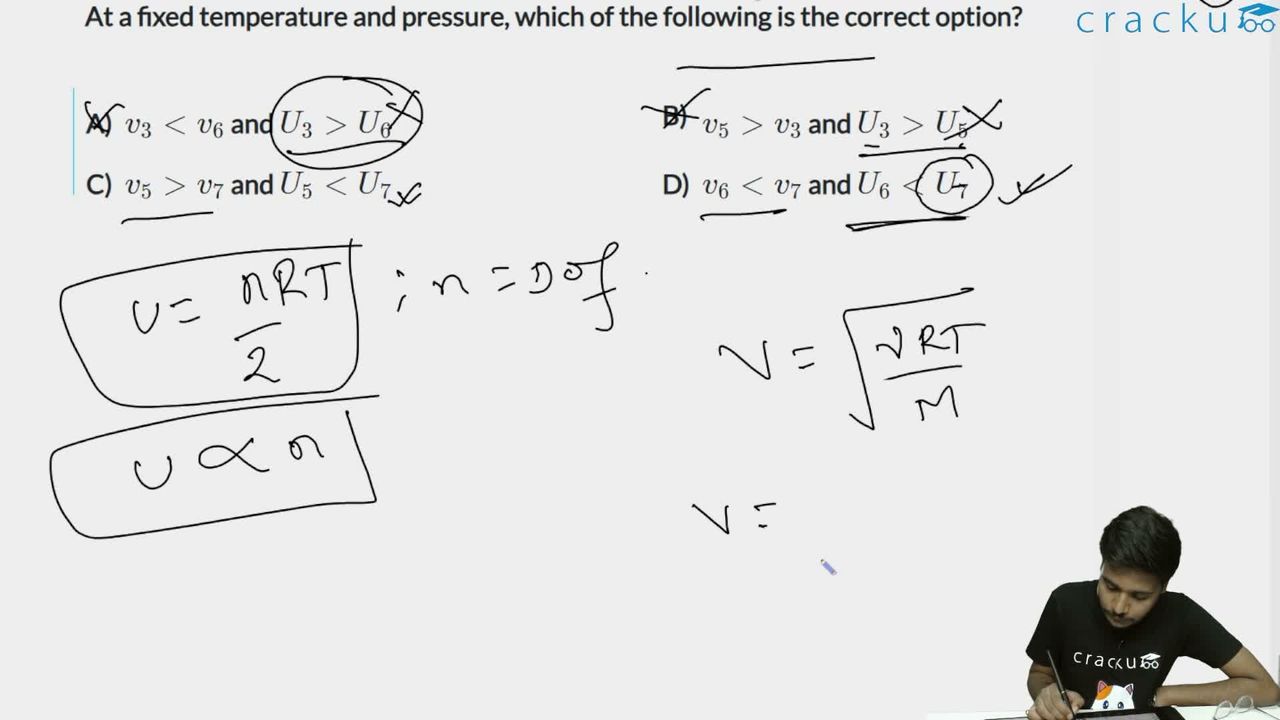
An ideal gas is in thermodynamic equilibrium. The number of degrees of freedom of a molecule of the gas is $$n$$. The internal energy of one mole of the gas is $$U_n$$ and the speed of sound in the gas is $$v_n$$. At a fixed temperature and pressure, which of the following is the correct option?
For an ideal gas with $$n$$ degrees of freedom, the molar heat capacities are
$$C_V=\frac{n}{2}R,\qquad C_P=C_V+R=\left(\frac{n}{2}+1\right)R$$
so that the ratio of specific heats (adiabatic index) is
$$\gamma=\frac{C_P}{C_V}=\frac{\frac{n}{2}+1}{\frac{n}{2}}=\frac{n+2}{n}=1+\frac{2}{n}$$
Hence $$\gamma$$ decreases when $$n$$ increases because the fraction $$2/n$$ gets smaller.
Internal energy per mole
Each quadratic degree of freedom contributes $$\tfrac12 kT$$ per molecule. For one mole this gives
$$U_n=\frac{n}{2}RT$$
Thus $$U_n$$ is directly proportional to $$n$$: more degrees of freedom ⇒ larger internal energy.
Speed of sound
For an ideal gas the speed of sound is
$$v_n=\sqrt{\frac{\gamma RT}{M}}$$
where $$M$$ is the molar mass (taken the same while comparing different values of $$n$$). Because $$R,T,M$$ are fixed,
$$v_n\propto\sqrt{\gamma}=\sqrt{1+\frac{2}{n}}$$
The function $$\sqrt{1+\dfrac{2}{n}}$$ decreases as $$n$$ increases, so the speed of sound is larger for smaller $$n$$.
Case 1: $$n=5$$ (typical diatomic gas)
$$\gamma_5=\dfrac{7}{5}=1.4,\qquad v_5\propto\sqrt{1.4},\qquad U_5=\dfrac{5}{2}RT$$
Case 2: $$n=7$$ (typical nonlinear polyatomic gas)
$$\gamma_7=\dfrac{9}{7}\approx1.286,\qquad v_7\propto\sqrt{1.286},\qquad U_7=\dfrac{7}{2}RT$$
Comparing the two cases:
$$v_5 \gt v_7\quad\text{and}\quad U_5 \lt U_7$$
Only Option C states $$v_5 \gt v_7$$ and $$U_5 \lt U_7$$, so it is the correct choice.
Final answer: Option C which is: $$v_5 \gt v_7$$ and $$U_5 \lt U_7$$
Was this solution helpful?
Click on the Email ☝️ to Watch the Video Solution
Create a FREE account and get:
_1.webp)

Educational materials for JEE preparation

Ask our AI anything

AI can make mistakes. Please verify important information.
AI can make mistakes. Please verify important information.
