
Join Our JEE Preparation Group
Prep with like-minded aspirants; Get access to free daily tests and study material.
Sign in
Please select an account to continue using cracku.in
↓ →
Join Our JEE Preparation Group
Prep with like-minded aspirants; Get access to free daily tests and study material.
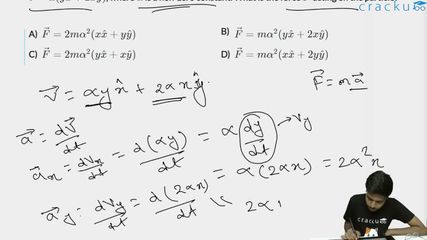
A particle of mass m is moving in the $$xy$$-plane such that its velocity at a point $$(x, y)$$ is given as $$\vec{v} = \alpha(y\hat{x} + 2x\hat{y})$$, where $$\alpha$$ is a non-zero constant. What is the force $$\vec{F}$$ acting on the particle?
The velocity field is $$\vec v = \alpha\bigl(y\,\hat x + 2x\,\hat y\bigr)$$.
Hence
$$v_x = \alpha y , \qquad v_y = 2\alpha x$$
Acceleration is the material (total) derivative of velocity:
$$\vec a = \frac{d\vec v}{dt} = v_x\frac{\partial\vec v}{\partial x} + v_y\frac{\partial\vec v}{\partial y}$$
Component $$a_x$$:
$$a_x = v_x\frac{\partial v_x}{\partial x} + v_y\frac{\partial v_x}{\partial y}$$
Since $$v_x = \alpha y$$, we have $$\frac{\partial v_x}{\partial x}=0$$ and $$\frac{\partial v_x}{\partial y}=\alpha$$.
Therefore $$a_x = v_x(0) + v_y(\alpha) = (2\alpha x)(\alpha) = 2\alpha^{2}x$$.
Component $$a_y$$:
$$a_y = v_x\frac{\partial v_y}{\partial x} + v_y\frac{\partial v_y}{\partial y}$$
Because $$v_y = 2\alpha x$$, we have $$\frac{\partial v_y}{\partial x}=2\alpha$$ and $$\frac{\partial v_y}{\partial y}=0$$.
Thus $$a_y = v_x(2\alpha) + v_y(0) = (\alpha y)(2\alpha) = 2\alpha^{2}y$$.
Combining the two components:
$$\vec a = 2\alpha^{2}\bigl(x\,\hat x + y\,\hat y\bigr)$$
Using Newton’s second law $$\vec F = m\vec a$$:
$$\vec F = 2m\alpha^{2}\bigl(x\,\hat x + y\,\hat y\bigr)$$
Therefore, the correct option is:
Option A which is: $$\vec{F} = 2m\alpha^{2}(x\hat{x} + y\hat{y})$$.
Was this solution helpful?
Click on the Email ☝️ to Watch the Video Solution
Create a FREE account and get:
_1.webp)

Educational materials for JEE preparation

Ask our AI anything

AI can make mistakes. Please verify important information.
AI can make mistakes. Please verify important information.
