
Join Our JEE Preparation Group
Prep with like-minded aspirants; Get access to free daily tests and study material.
Sign in
Please select an account to continue using cracku.in
↓ →
Join Our JEE Preparation Group
Prep with like-minded aspirants; Get access to free daily tests and study material.
An annular disk of mass $$M$$, inner radius $$a$$ and outer radius $$b$$ is placed on a horizontal surface with coefficient of friction $$\mu$$, as shown in the figure. At some time, an impulse $$J_0 \hat{x}$$ is applied at a height h above the center of the disk. If $$h = h_m$$ then the disk rolls without slipping along the x-axis. Which of the following statement(s) is(are) correct?
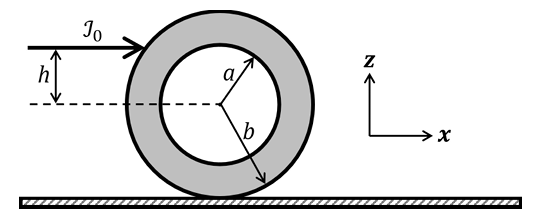
The impulse $$\vec J_0 = J_0\,\hat x$$ is applied at a point situated a vertical distance $$h$$ above the centre of mass (COM) of the annular disc. Choose the co-ordinate system • origin at the COM, • $$x$$-axis along the direction of the impulse (and of the subsequent translation), • $$y$$-axis horizontal and perpendicular to the plane of the disc (i.e. along the axle), • $$z$$-axis vertically upward.
1. Linear impulse-momentum relation
The impulse imparts a COM velocity
$$v = \frac{J_0}{M}$$
along the $$+x$$-direction.
2. Angular impulse-momentum relation
The position vector of the point of application is $$\vec r = h\,\hat z$$.
The impulse produces an angular impulse
$$\vec \tau \,\Delta t = \vec r \times \vec J_0 = hJ_0\,\hat y.$$
Hence the disc acquires an angular momentum about the $$y$$-axis equal to $$hJ_0$$.
For an annular disc the moment of inertia about a diameter (the $$y$$-axis here) is
$$I_y = \frac{1}{2}M(a^2+b^2)\;.$$
Therefore the initial angular velocity about the $$y$$-axis is
$$\omega = \frac{hJ_0}{I_y} = \frac{2hJ_0}{M\,(a^2+b^2)}.$$
3. Condition for instantaneous pure rolling
For rolling without slipping, the velocity of the point of contact with the floor must be zero.
The lowest point is at a distance $$b$$ below the COM, i.e. $$\vec r_c = -\,b\,\hat z$$.
Its velocity relative to the ground is
$$\vec v_c = \vec v\;+\;\vec\omega \times \vec r_c
= \frac{J_0}{M}\,\hat x \;+\;\omega\,\hat y \times (-\,b\,\hat z)
= \left(\frac{J_0}{M} - \omega b\right)\hat x.$$
The rolling condition $$\vec v_c = 0$$ therefore gives
$$\frac{J_0}{M} = \omega b.$$
Substituting $$\omega$$ from step 2,
$$\frac{J_0}{M} = \frac{2hJ_0}{M(a^2+b^2)}\,b
\quad\Longrightarrow\quad
h = \frac{a^2+b^2}{2b}\;.$$
4. Optimum height
Thus the unique height at which the impulse must be delivered so that the disc starts pure rolling immediately is
$$h_m = \frac{a^2+b^2}{2b}\;.$$
5. Verification of the given options
• Take the limiting case $$a \to 0$$ (a solid disc).
Then $$h_m \to \dfrac{b^2}{2b} = \dfrac{b}{2}\;,$$
which coincides with Option A. ✅
Hence, the correct statement is:
Option A which is: For $$\mu \neq 0$$ and $$a \to 0$$, $$h_m = b/2$$.
Was this solution helpful?
Create a FREE account and get:
_1.webp)

Educational materials for JEE preparation

Ask our AI anything

AI can make mistakes. Please verify important information.
AI can make mistakes. Please verify important information.
