
Join Our JEE Preparation Group
Prep with like-minded aspirants; Get access to free daily tests and study material.
Sign in
Please select an account to continue using cracku.in
↓ →
Join Our JEE Preparation Group
Prep with like-minded aspirants; Get access to free daily tests and study material.
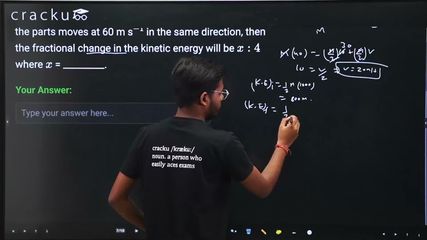
A block moving horizontally on a smooth surface with a speed of 40 m s$$^{-1}$$ splits into two equal parts. If one of the parts moves at 60 m s$$^{-1}$$ in the same direction, then the fractional change in the kinetic energy will be $$x : 4$$ where $$x$$ = _________.
Correct Answer: 1
Let us denote the original (total) mass of the block by $$m$$ and its initial speed by $$u = 40\ \text{m s}^{-1}$$. Since the surface is smooth, there is no external horizontal force, so the linear momentum of the system will be conserved at the instant the block splits.
After splitting, the block forms two equal parts, each of mass $$\dfrac{m}{2}$$. One part is observed to move in the same original direction with speed $$60\ \text{m s}^{-1}$$. We shall call the speed of the other part $$v$$ (also in the original direction, because nothing in the statement suggests reversal).
Conservation of linear momentum states:
$$\text{Initial momentum} = \text{Final total momentum}.$$
Mathematically,
$$m\,u = \frac{m}{2}\,(60) + \frac{m}{2}\,v.$$
Substituting $$u = 40\ \text{m s}^{-1}$$, we have
$$m\,(40) = \frac{m}{2}\,(60) + \frac{m}{2}\,v.$$
Cancelling the common factor $$m$$ on both sides:
$$40 = 30 + \frac{v}{2}.$$
Re-arranging,
$$40 - 30 = \frac{v}{2}\quad\Longrightarrow\quad 10 = \frac{v}{2}.$$
So,
$$v = 20\ \text{m s}^{-1}.$$
Now we evaluate the kinetic energies.
The initial kinetic energy of the single block is given by the familiar formula $$K = \dfrac12 m u^{2}$$:
$$K_{\text{initial}} = \frac12\,m\,(40)^{2} = \frac12\,m\,(1600) = 800\,m.$$
The final kinetic energy is the sum of the kinetic energies of the two fragments:
$$K_{\text{final}} = \frac12\left(\frac{m}{2}\right)(60)^{2} + \frac12\left(\frac{m}{2}\right)(20)^{2}.$$
Simplifying step by step,
$$K_{\text{final}} = \frac{m}{4}\bigl(60^{2} + 20^{2}\bigr) = \frac{m}{4}\bigl(3600 + 400\bigr) = \frac{m}{4}\,(4000) = 1000\,m.$$
The change in kinetic energy is therefore
$$\Delta K = K_{\text{final}} - K_{\text{initial}} = 1000\,m - 800\,m = 200\,m.$$
The fractional change (ratio of the change to the original value) is
$$\frac{\Delta K}{K_{\text{initial}}} = \frac{200\,m}{800\,m} = \frac14.$$
The problem states that this fractional change can be written in the form $$x : 4$$. Comparing, we identify
$$x = 1.$$
So, the answer is $$1$$.
Was this solution helpful?
Click on the Email ☝️ to Watch the Video Solution
Create a FREE account and get:
_1.webp)

Educational materials for JEE preparation

Ask our AI anything

AI can make mistakes. Please verify important information.
AI can make mistakes. Please verify important information.
