
Join Our JEE Preparation Group
Prep with like-minded aspirants; Get access to free daily tests and study material.
Sign in
Please select an account to continue using cracku.in
↓ →
Join Our JEE Preparation Group
Prep with like-minded aspirants; Get access to free daily tests and study material.
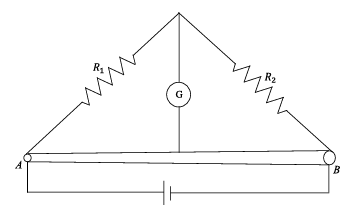
Two resistances $$R_1 = X$$ $$\Omega$$ and $$R_2 = 1$$ $$\Omega$$ are connected to a wire AB of uniform resistivity, as shown in the figure. The radius of the wire varies linearly along its axis from 0.2 mm at A to 1 mm at B. A galvanometer (G) connected to the center of the wire, 50 cm from each end along its axis, shows zero deflection when A and B are connected to a battery. The value of X is _______.
Correct Answer: 5
The wire $$AB$$ is of length $$L = 1\,$$m and has uniform resistivity $$\rho$$, but its radius varies linearly from
$$r_A = 0.2\text{ mm} = 0.0002\,$$m at $$A$$ to $$r_B = 1\text{ mm} = 0.001\,$$m at $$B$$.
Let the distance measured from end $$A$$ be $$x$$. Because the radius changes linearly,
$$r(x) = r_A + (r_B - r_A)\frac{x}{L} = 0.0002 + 0.0008\,x \quad (0 \le x \le 1)$$
The cross-sectional area at position $$x$$ is $$A(x) = \pi\,r(x)^2$$.
For an element of length $$dx$$ the resistance is
$$dR = \frac{\rho\,dx}{A(x)} = \frac{\rho\,dx}{\pi\,[\,0.0002 + 0.0008x\,]^2}$$
Integrating gives the resistance between any two points. The integral needed is
$$\int \frac{dx}{(a + bx)^2} = -\frac{1}{b\,(a + bx)} \qquad\text{where } a = 0.0002,\; b = 0.0008$$
Resistance of segment $$AC$$ (first 0.5 m)
$$R_{AC} = \frac{\rho}{\pi}\,\frac{1}{b} \Bigg[\,\frac{1}{a} - \frac{1}{a + 0.5\,b}\,\Bigg]$$
Substituting $$\frac{1}{a} = \frac{1}{0.0002} = 5000$$ $$\frac{1}{a + 0.5\,b} = \frac{1}{0.0002 + 0.0004} = \frac{1}{0.0006} = 1666.67$$
$$\Rightarrow R_{AC} \propto 5000 - 1666.67 = 3333.33$$
Resistance of segment $$CB$$ (last 0.5 m)
$$R_{CB} = \frac{\rho}{\pi}\,\frac{1}{b} \Bigg[\,\frac{1}{a + 0.5\,b} - \frac{1}{a + b}\,\Bigg]$$
Substituting $$\frac{1}{a + b} = \frac{1}{0.0002 + 0.0008} = \frac{1}{0.001} = 1000$$
$$\Rightarrow R_{CB} \propto 1666.67 - 1000 = 666.67$$
Ratio of the two wire resistances
$$\frac{R_{AC}}{R_{CB}} = \frac{3333.33}{666.67} = 5$$
The galvanometer is connected at the midpoint of the wire, forming a Wheatstone bridge with arms:
Left arm: $$R_1$$ in series with $$R_{AC}$$ Right arm: $$R_2$$ in series with $$R_{CB}$$
For zero deflection (bridge balance),
$$\frac{R_1}{R_2} = \frac{R_{AC}}{R_{CB}} = 5$$
Given $$R_2 = 1\,\Omega$$,
$$R_1 = 5 \times 1 = 5\,\Omega$$
Therefore, the required value of $$X$$ is 5.
Was this solution helpful?
Create a FREE account and get:
_1.webp)

Educational materials for JEE preparation

Ask our AI anything

AI can make mistakes. Please verify important information.
AI can make mistakes. Please verify important information.
